Firefighting Is Rewarded. Prevention Isn't. Why Continuous Improvement Initiatives Die.
Your continuous improvement program didn't die from weak discipline. It died because your reward system pays for firefighting and stays silent on prevention.
July 30, 2026 · Updated August 13, 2026
The Fires Get Thanked. The Prevention Project Gets Postponed.
"Continuous improvement rarely collapses because people reject it," operations leader Moss M. Jacques wrote in March 2026. "It collapses because the organization praises improvement while continuing to reward the behaviors that make improvement impossible. It says it wants prevention, but measures recovery speed."
If that landed with recognition, you've probably watched this pattern from inside it.
Here is a version of it you may not have named out loud: some of the people being thanked this week for heroic response (the supervisor who ran double shifts to recover a missed shipment, the technician who got the line back up at midnight) are sometimes the same people whose deferred inspection or ignored warning signal made the fire possible. That is not an accusation. It is a recognizable pattern in plants that reward speed of recovery and have no parallel measure for prevention.
One operations manager put it bluntly: "About 80% of these initiatives quietly collapse within six months, back into full firefighting." That is one operator's estimate, not a published figure. But if you have led more than one continuous improvement (CI) push, it probably does not surprise you.
The explanation most experienced operators offer for why their last initiative died sounds like one of these: the team lost discipline when the pressure hit; leadership stopped championing it once the quarter got busy; the approach wasn't the right fit for our floor. Those explanations are not unreasonable. They point to real things that happened.
What they don't explain is why it happens the same way every time in plants with different teams, leadership, and approaches. The momentum is always real, and the collapse always arrives on the same schedule, driven by the same kind of crisis.
This article will identify the mechanism that those explanations leave out.
The Explanation You Came In With Isn't Wrong. It's Incomplete.
The kaizen event you're remembering probably had a real kickoff. Standing room in the conference room. Leadership in the front row. Genuine energy from the floor team who'd been waiting for this. The whiteboard covered in waste categories and ranked opportunities.
Three weeks later, the follow-up meeting wasn't on the calendar. Not canceled. It just never got rescheduled. The crisis in Cell 4 had consumed that Tuesday. Quarter-end took the next one. By the time the calendar opened again, the window had closed.
If that sequence is familiar, you are not remembering an outlier. A systematic review of the peer-reviewed manufacturing literature found that CI initiatives commonly and predictably fail, with the causal cluster mapping to leadership, culture, motives and expectations, implementation approach, training, and feedback and results systems (McLean & Antony, 2014). Not method selection. Not team capability. Not the system on the whiteboard.
Those explanations are not unreasonable. The team did lose discipline when the pressure hit. Leadership did stop protecting the time. The approach may have been a genuine mismatch for the floor. Those things happened.
The problem is that they don't account for the regularity. Plants with strong teams collapse. Plants with visible leadership sponsorship collapse. Plants that switched approaches and relaunched collapse, often on the same schedule, driven by the same class of crisis. If discipline, sponsorship, or approach selection were the cause, you'd expect more variation in outcomes when you changed them. The outcomes don't vary the way the cause would predict.
That is the gap the proximate explanations leave open.
The Named Mechanism: Rewarding A While Hoping for B
In 1975, Steven Kerr published a paper in the Academy of Management Journal with a title that functions as a complete thesis: "On the Folly of Rewarding A, While Hoping for B" (Kerr, 1975). His core observation, made across industries and organizational types, not specific to manufacturing, was that organizations routinely design reward systems that pay out on behaviors contrary to their stated goals. They say they want one thing. They fund another. The outcomes follow the funding.
It is a named, peer-reviewed pattern with fifty years of documented history. And it describes your CI initiative with uncomfortable precision.
A is fast, visible, heroic fire recovery. The plant leader who pulled an all-nighter and had production back before the morning shift. The supervisor whose legend on the floor is built on crisis response, who gets called first when something breaks, who the team trusts to get them through. That person gets thanked in the all-hands. Their name gets mentioned to the vice president. A career is built on those moments.
B is quiet, invisible prevention. The preventive-maintenance schedule that runs clean and keeps the machine that never breaks from breaking. The 5S project that eliminates the condition requiring the all-nighter. The kaizen initiative that improves yield without ever producing a crisis to recover from. Prevention work succeeds by producing nothing visible: no emergency, no rescue, no story. It does not generate the recognition signal that A generates.
Under the first real pressure (a customer escalation, a breakdown, a production shortfall), A wins automatically. The team member who abandons the improvement project to fight the fire is not making a bad decision. They are responding rationally to the reward system they operate inside. It was built to pay out on A. It is working exactly as designed.
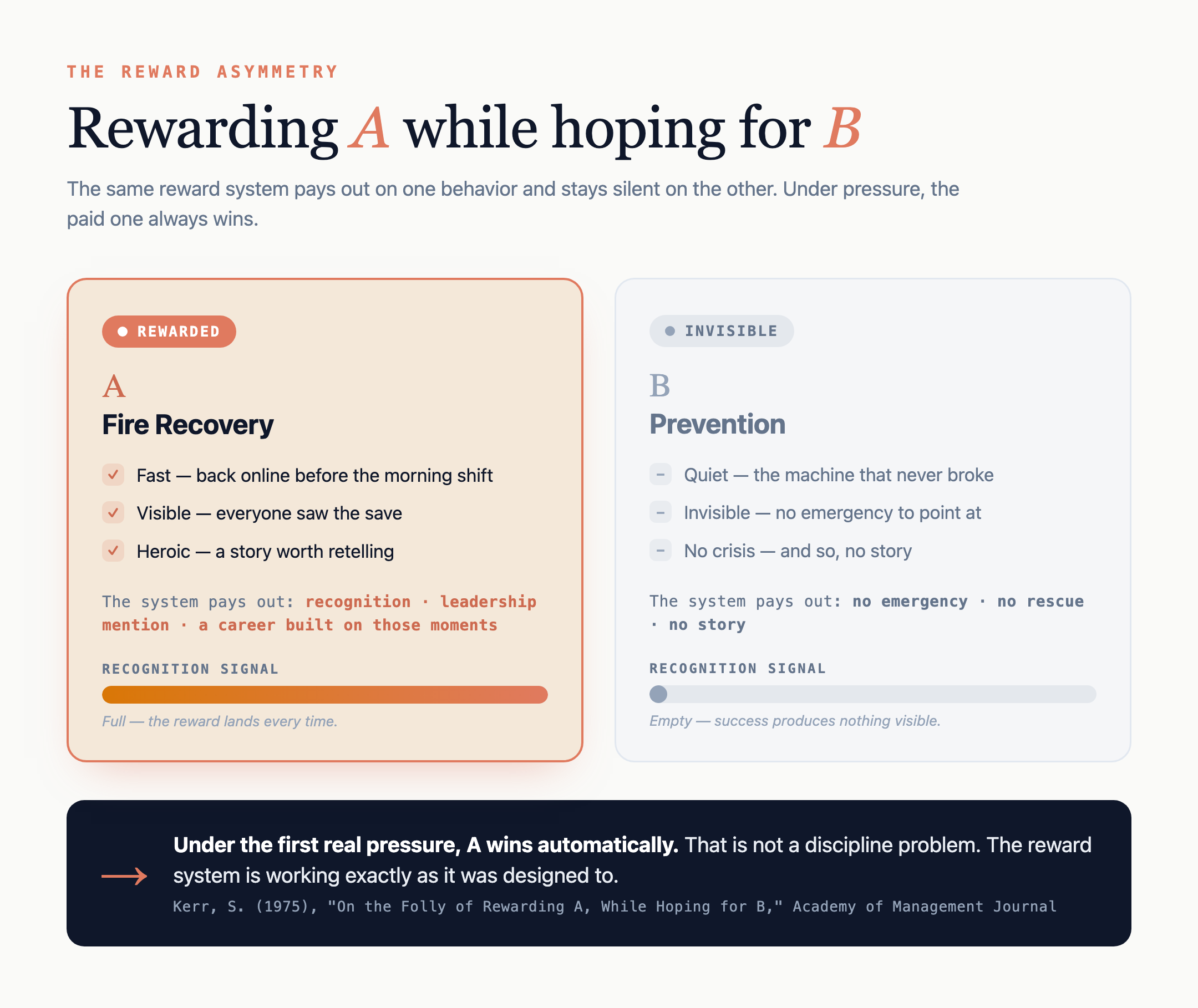
That is Kerr's point: this is not a discipline problem. No amount of team commitment can outrun a reward system working in the opposite direction.
The systematic review by McLean and Antony identifies the CI failure cluster in manufacturing as leadership, culture, motives and expectations, and feedback and results systems (McLean & Antony, 2014). Each of those categories is a component of the reward environment: who leadership recognizes, what the culture celebrates, what expectations get reinforced, what results get measured. That is the Kerr pattern in manufacturing terms, and it explains why switching to a different approach or adding more rigorous training leaves the collapse schedule unchanged.
The mechanism has a name: rewarding A while hoping for B, documented in the Academy of Management Journal in 1975 (Kerr, 1975). That phrase and its citation are portable. They survive any leadership conversation, budget review, or post-mortem where someone needs to explain why the team that tried hardest still lost to the system they were operating inside.
Why the People Inside the System Genuinely Can't See It
If the pattern is this well-documented, why can't the people running the system see it? Two mechanisms explain this. Neither is a character flaw.
The Sinclair mechanism: belief follows the payslip
Upton Sinclair put it directly: "It is difficult to get a man to understand something when his salary depends on his not understanding it" (Sinclair, 1934).
Apply this to the plant leader. Their annual review is built on crisis response. Their career story is the outage they prevented from becoming a customer miss, the shift they saved at midnight. Recognition follows the same pattern. Bonuses tie to throughput targets held under pressure, not to the quiet absence of breakdowns.
That leader is not lying when they say they want prevention. They mean it. But their genuine belief follows the compensation narrative: firefighting is important, visible, career-making work. Prevention is good in theory, but not as concrete, not as urgently recognized, not as directly tied to the outcomes that matter to the people evaluating them. The Sinclair mechanism requires no bad faith. It requires only that the salary precede the belief, which it always does.
The Sutherland mechanism: the system has consumed the slack
Rory Sutherland argues in Alchemy that organizational slack (spare capacity, unscheduled time, the engineer who isn't already pulled somewhere) is what enables organizations to notice and act on non-urgent opportunities (Sutherland, 2019). Remove the slack, and you remove the conditions under which prevention work can survive. The open slot on Tuesday morning for a preventive-maintenance review is the one that disappears when Cell 4 goes down. Leadership attention, the scarcest slack of all, is occupied by the morning's escalation.
The compounding loop
These two mechanisms compound rather than run in parallel. The Sinclair mechanism ensures that people within the system believe firefighting is genuinely valuable; the Sutherland mechanism ensures that the system has consumed the resources that prevention work would need to take root. Nothing inside the loop generates the signal that would prompt correction, and the capacity an alternative would require has already been spent.
What the Collapse Actually Looks Like
The mechanism does not stay abstract. The supervisor who recovered this week's crisis gets named at Monday's standup; the improvement project's Tuesday morning slot has quietly disappeared from the calendar for three weeks, preempted each time by something that felt urgent. Nobody formally canceled it. The reward system did that, without anyone noticing.
Eighteen months later, a new initiative launches. Different name, possibly a different system, genuine early momentum. The same first real operational pressure arrives. The same structural outcome follows. The cycle repeats not because the team failed to learn, but because the reward system has not changed between the first collapse and the relaunch. The learning was real. The structure was not.
Chris Reep, who writes on manufacturing alignment, puts it at roughly 80% of continuous improvement initiatives quietly collapsing within six months, with management defaulting "right back to chaotic firefighting" and improvement trackers becoming "historical wall decorations." That is one practitioner's estimate rather than a controlled study, and it should be read as such.
Jacques names the contradiction directly: the organization praises improvement while continuing to reward the behaviors that make improvement impossible. It wants prevention and measures recovery speed.
The collapse is not evidence of a team that failed. It is evidence of a reward system that succeeded at exactly what it was built to do. The diagnosis changes what the correct response is.
Getting the Diagnosis Right Changes What You Do Next
A reward system that scores firefighting and ignores prevention will defeat any improvement initiative operating outside it. Before reaching for the usual responses, verify whether the Kerr pattern is what you are looking at.
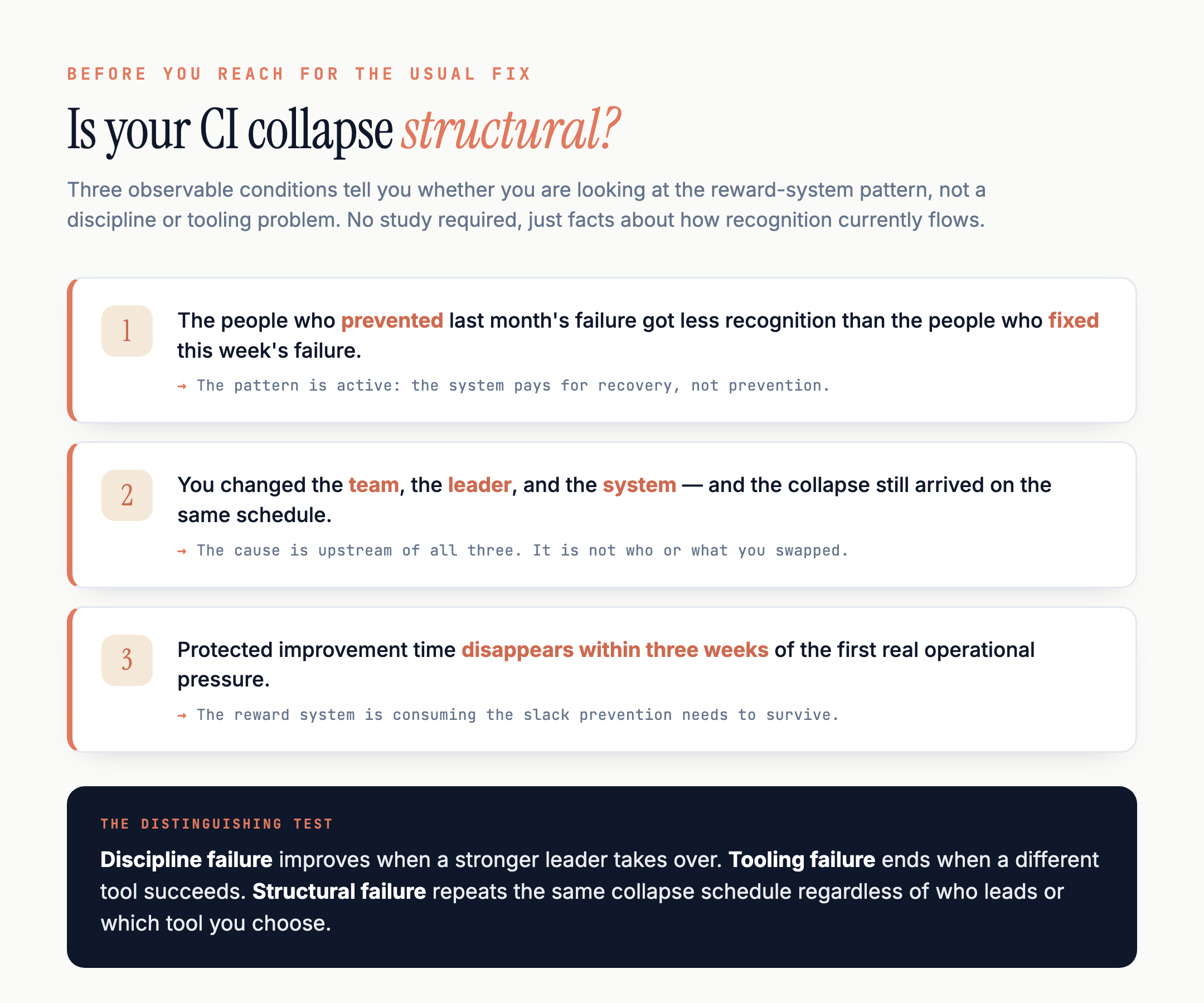
Three observable conditions confirm it. If the people who prevented last month's failure received less recognition than the people who fixed this week's failure, the pattern is active. If you changed the team, the leader, and the system and the collapse arrived on the same schedule, the cause is upstream of all three. If protected improvement time disappears within three weeks of the first real operational pressure, the reward system is consuming the slack.
The distinction from a discipline or tooling failure matters because the responses differ. Discipline failure improves when a stronger leader takes over; structural failure does not. Tooling failure shows the same team succeeding with a different tool; structural failure repeats the same collapse schedule regardless of which tool is chosen.
Two questions worth bringing to a Monday meeting: "In the last quarter, how many people were publicly recognized for preventing a problem versus recovering from one?" And: "When the last improvement project lost its calendar slot, what took its place, and did that replacement get recognized?" The answers are observable facts about how the reward system is currently running. No study required.
The four wrong responses, and why each fails the diagnosis
-
Renewed leadership commitment. A plant leader who resolves to protect improvement time is asking willpower to override a reward system that keeps paying out for firefighting. The next outage does not arrive as a test of resolve. It arrives as the crisis that the leader's recognition and career story are built around managing. Kerr is explicit: awareness of the misalignment is insufficient to change its effect (Kerr, 1975). Intention cannot outrun structure.
-
Stronger change management. Change management is the right response to a change-adoption problem. A reward-system misalignment is not a change-adoption problem. Better communication and cross-functional workshops do not change what the organization scores; they make the initiative more legible while the scoring system continues to defeat it.
-
More rigorous method selection. Whether the next initiative runs on Lean, Six Sigma, or a hybrid is irrelevant if the reward system defeats whichever one is chosen. Method selection belongs downstream of the structural question, not in place of it.
-
Better buy-in campaigns. Social consensus about the importance of prevention does not change what gets measured or rewarded. An organization that already believes improvement matters will respond with genuine agreement, and then the same collapse, for the same structural reason.
What a structural response requires
Kerr's argument is that the reward structure itself must change, not that leaders must commit more sincerely to wanting different outcomes (Kerr, 1975). In organizational terms: give improvement work its own scored footing on leadership's existing scoreboard, visible and ranked, competing directly alongside the metrics that already command attention.
In practitioners' terms, the structural condition is a scored, ranked, board-ready portfolio that gives improvement work an evidentiary standing able to survive budget scrutiny and leadership turnover rather than yielding to the next fire.
The distinction from every motivational fix is this: it changes what the system rewards, not what people intend. Improvement work needs its own place on the scoreboard, where it competes rather than loses invisibly.
What Survives Isn't the Most Disciplined Team. It's the Most Scored Portfolio.
A scored portfolio is not a tracking spreadsheet and not a kaizen log. The distinguishing feature is explicit, quantified return on investment (ROI) with a rank-ordered position on leadership's existing scoreboard, alongside and not beneath the production and delivery metrics that already command attention.
A kaizen log records what was tried. A scored portfolio ranks what is worth doing, with a projected return attached to each initiative and a visible position on the same board that tracks production and delivery. When the next budget conversation happens, or the next crisis reallocates protected time, the conversation is not "should we protect improvement work?" It is: "this initiative ranks third on the scoreboard, the projected return clears the payback threshold, and here is why the assumptions behind it hold."
The improvement initiative now competes. It does not win automatically. But it is no longer invisible.
The evidentiary standard it must clear
This matters because the final authority on whether improvement work gets funded sits in finance. In operations this size, spending above roughly $20K stops being an operations decision and becomes a finance one, judged against a return standard that is not negotiable. That is the bar a board-ready portfolio must be built to survive.
A spreadsheet or gut-feel priority list does not survive that conversation. A scored portfolio, with explicit assumptions, traceable data behind each initiative's projected return, and a visible rank against competing investment options, is built for exactly that conversation. The portfolio's job is to pre-build the evidentiary case so that when finance asks "what are we getting for this," the answer is already in the room.
The build-it-yourself problem and the structured alternative
Building and maintaining a scored portfolio without dedicated infrastructure is itself a willpower task. Someone has to design the scoring approach, keep the rankings current as conditions change, and translate operations data into the ROI language that survives finance scrutiny. For most vice presidents of operations or engineering directors running a 50–200-person plant, that maintenance overhead falls off when the next outage arrives, for exactly the reason this article has documented (Kerr, 1975).
Hephanos provides the scored, board-ready portfolio without requiring that infrastructure to be built and sustained from scratch. The choice is between building the scoring system yourself and having a structured approach that keeps the portfolio board-ready by design, so the evidentiary case is there when the next budget conversation happens.
If improvement work on your operation currently competes with disappearing, see what a scored, board-ready improvement portfolio looks like for a manufacturing operation like yours.
A note on the ~80% figure. It is a practitioner estimate, not a peer-reviewed statistic, and we have not found a study that establishes it. The underlying mechanism is better supported than the number is: it rests on Kerr's account of misaligned reward systems and on the documented pattern of continuous-improvement failure in manufacturing.
Sources
- Kerr, S. (1975). "On the Folly of Rewarding A, While Hoping for B." Academy of Management Journal, 18(4). https://doi.org/10.2307/255378
- McLean, R., & Antony, J. (2014). "Why continuous improvement initiatives fail in manufacturing environments? A systematic review of the evidence." International Journal of Productivity and Performance Management, 63(3). https://doi.org/10.1108/ijppm-07-2013-0124
- Sinclair, U. (1934). I, Candidate for Governor: And How I Got Licked. University of California Press.
- Sutherland, R. (2019). Alchemy: The Dark Art and Curious Science of Creating Magic in Brands, Business, and Life. William Morrow.
- Jacques, M. M. Practitioner commentary on the reward contradiction, public LinkedIn post, captured 2026-06-22. https://www.linkedin.com/posts/moss-m-jacques-054273271_auditreadiness-operations-businessstrategy-activity-7474792826602651648-COqL
- Reep, C. Practitioner commentary on the six-month collapse pattern, public LinkedIn post, captured 2026-06-22. https://www.linkedin.com/posts/chris-reep-2bb839245_announcing-the-launch-of-the-daily-alignment-activity-7469412514666242048-tx-B
Corrections
2026-08-13. Source 2 carried the wrong DOI, journal and issue. The identifier we published (10.1108/IJQRM-09-2013-0147) resolves to Albliwi et al. (2014), a different paper. McLean & Antony (2014) appeared in the International Journal of Productivity and Performance Management, 63(3), DOI 10.1108/ijppm-07-2013-0124. The reference now points to the paper the article actually relies on. No claim in the body changed.