Why Improvement Initiatives Fail in Manufacturing: It's a Discovery Problem, Not Execution
Why improvement initiatives fail in manufacturing: the failure is decided at discovery, before execution, and more governance cannot fix it.
July 10, 2026 · Updated July 10, 2026
Why Do Improvement Initiatives Fail in Manufacturing?
When a manufacturing improvement initiative fails, the cause sits further upstream than the post-mortem records: the initiative was aimed at the wrong problem before any project was chartered. The real failure is in how opportunities are selected, not in how the work later gets done. I would argue that better follow-through cannot fix a problem that was mis-selected.
Picture the kickoff. A cross-functional team. A deck with twelve prioritized opportunities, color-coded, ranked by estimated impact, approved by leadership. Operations, engineering, quality, and finance aligned in a conference room for the first time in years. The project plan is credible. The team is capable. The commitment feels genuine.
Six months later, the initiative has stalled. The team is exhausted. The backlog looks nearly identical to what it did at kickoff. Nothing shipped. No measurable constraint addressed. The quarterly numbers didn't move.
The post-mortem is brief and familiar. The verdict: we needed better follow-through. Governance was too loose. Accountability was diffuse. Project discipline was inconsistent. The organization responds the way it always does: more oversight. More dashboards. More check-ins. A tighter commitment to execution.
That verdict feels earned. The timeline slipped. Resources pulled. Scope expanded without authorization. The evidence of execution failure is visible and legible, and the team worked hard. So the failure must live downstream, in the discipline layer.
But the verdict survives only as long as nobody asks the harder question: what if the failure was decided before the first project meeting? What if six months of disciplined execution was never going to deliver results? Not because the team underperformed, but because the initiative was pointed at the wrong problem from the start.
That question doesn't appear in most post-mortems. The verdict always produces the same prescription. The next cycle begins with the same assumption about where the problem lives.
The Verdict Is Always the Same: We Need Better Follow-Through
The verdict isn't irrational. It reflects what the post-mortem can actually see. Schedule slips are documented. Resources get pulled mid-cycle, with meeting invites cancelled and headcount redirected. Scope expands without authorization. The team's effort compounds the diagnosis: people worked hard, showed up, delivered updates, and the failure wasn't indifference. When genuine investment meets visible failure, the gap has to live somewhere, and the somewhere that is legible is execution quality: discipline, governance, accountability, follow-through.
Post-mortems are downstream instruments. They measure what is visible after the fact: timelines missed, resources withdrawn, scope that drifted. That is not a design flaw; the instrument works as designed. It surfaces what happened during execution because execution is where the observable evidence lives.
The problem is not that the verdict is wrong about what it measured. The problem is that it is aimed at the wrong layer entirely, and the layer it cannot see is where the failure was already decided.
The Post-Mortem Is Looking in the Wrong Direction
The post-mortem found what it was built to find. What it missed is where the failure actually lived.
Across the peer-reviewed literature, the average reported failure rate of Six Sigma implementation sits around 60–70%, with roughly 60% of corporate Six Sigma initiatives failing to yield their desired results [Sony, Antony, Park & Mutingi, 2020]. These initiatives had methods, project charters, trained practitioners, and governance structures. Something failed upstream of all of that, before the first DMAIC gate, before any execution machinery was engaged.
A synthesis of systematic literature reviews on Lean Six Sigma failure factors suggests that upstream misidentification (wrong project selection, poor problem diagnosis, misalignment with strategy) accounts for roughly one-fifth to one-third of continuous improvement failure narratives. These are cross-study synthesis approximations, not precise measurements from a single study. But the directional implication holds: a meaningful share of initiative failures are decided at the selection stage, not the delivery stage.
The diagnostic paradox explains why this stays invisible. In a Walden University survey of 210 practitioners who had participated in failed Six Sigma DMAIC projects, 76.7% (161/210) disagreed that their projects failed due to the method or incorrect scoping [Sands, Walden University]. Read carelessly, that sounds like evidence that scoping doesn't matter. It is evidence of the opposite: when post-mortems are conducted with downstream instruments, measuring what went wrong during execution, they cannot detect what was misaligned upstream before the charter was written. The instrument cannot see what it is not pointed at.
"The gap isn't the method — it's knowing what to point it at." — Imran Afzal
Accepting this diagnosis is more uncomfortable than accepting an execution verdict, because it implicates initiative selection, a leadership responsibility, not the team's delivery performance. Afzal names the structural fact directly: "organizations are interpretation systems before they are execution systems." The failure to resolve what matters most before chartering a project is not an execution gap. It is a discovery gap, the layer the post-mortem never reaches.
Discovery Before Execution: A Mental Model Worth Carrying Into Your Next Meeting
There is a name for the layer that most improvement cycles skip entirely: discovery. Not planning. Planning is scheduling and resource allocation, the machinery that organizes execution. Discovery is the structured process of interpreting the operational landscape to determine which problem, if addressed, unlocks the most value. The two are not the same, and conflating them is exactly how organizations end up executing with discipline toward the wrong target.
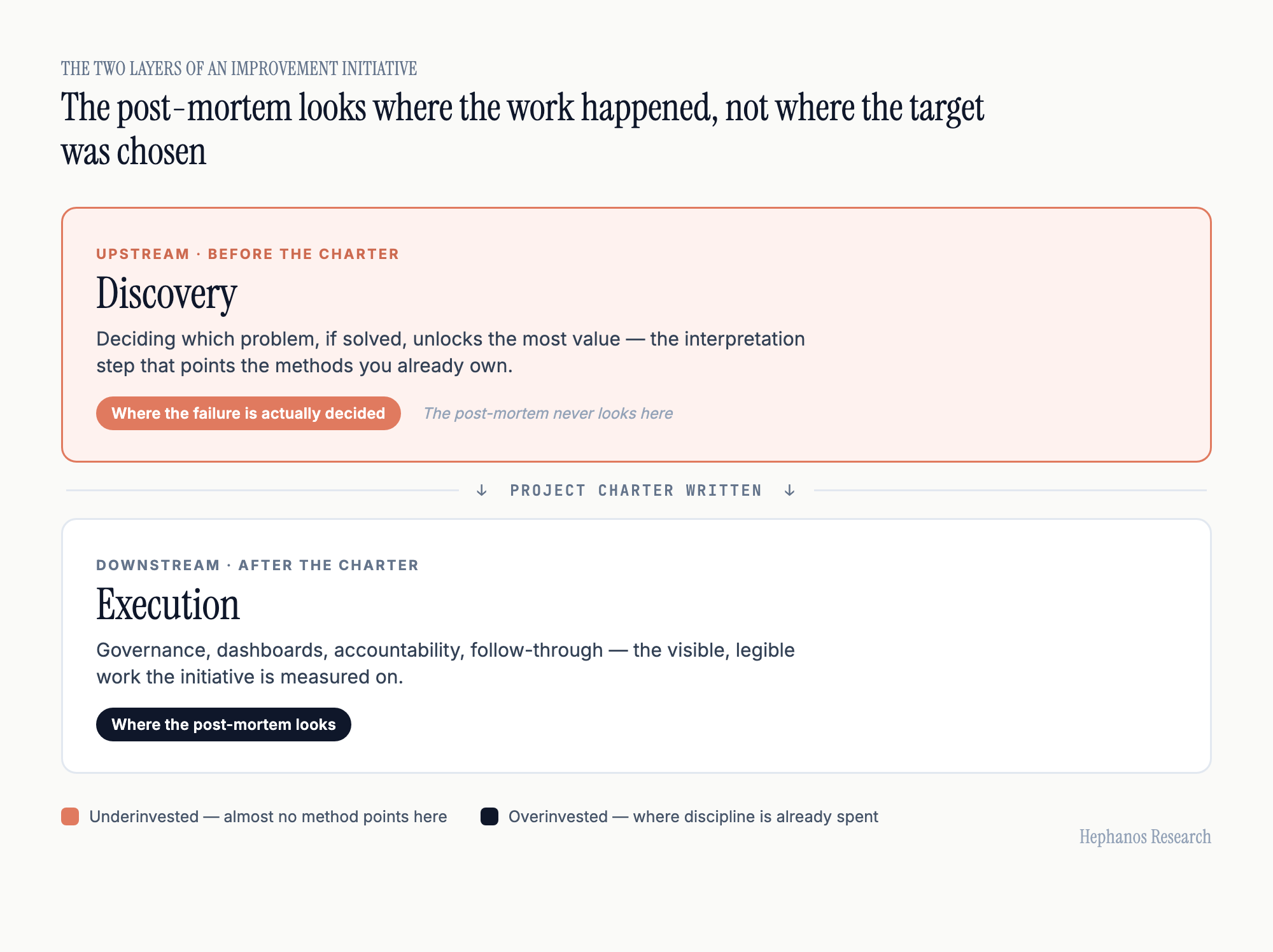
The operational translation is direct: the gap between "we see problems everywhere on the floor" and "we know which problem is the actual constraint" is a discovery gap, not an execution gap. Those are different problems with different interventions. An execution gap closes with better governance, tighter project discipline, and cleaner accountability. A discovery gap closes only with a structured interpretation process that precedes any project charter. On a plant floor showing throughput variation, quality escapes, and scheduling instability at once, the operational signals are real but competing, and which one is the actual constraint is not visible without an interpretation process.
Organizational theory explains why. Daft and Lengel's work on organizational information requirements establishes that when equivocality is high, when the question "what matters most?" remains unresolved, organizations require rich, iterative interpretation cycles before coordinated action becomes productive [Daft & Lengel, 1986]. Applied to manufacturing, discovery is the equivocality-resolution step. Until it runs, any direction is an advocacy outcome, not an evidence outcome, and execution discipline applied to an advocacy-selected target cannot close the gap that discovery was supposed to fill.
A composite example makes the distinction concrete; the pattern is representative, not a single named account. A mid-market plant charters a disciplined six-month initiative to cut changeover time on its most visible bottleneck, the line everyone points to in the operations review. The team executes well: changeover drops from roughly 45 minutes to 18, and local efficiency on that line improves measurably. Yet quarterly throughput barely moves. The reason surfaces only afterward. The true constraint was an upstream quality escape that forced rework two stations back, and the line the team optimized was never the system bottleneck. Execution was excellent. The target was wrong. No additional governance over the changeover project would have changed the outcome, because the initiative was mis-pointed before it was chartered.
To be precise about the claim: discovery-before-execution is not an argument that execution failures are absent. They exist, and the two layers interact. A team can select the right target and still fail through weak resourcing, misaligned incentives, or poor change management, and genuinely poor execution can bury an otherwise sound selection. The evidence in the previous section does not deny that two-thirds to four-fifths of continuous improvement failure narratives involve downstream factors. The claim here is narrower, and harder to dismiss: discovery is a major, systematically underdiagnosed cause of failure, and organizations overcorrect on execution while underinvesting in problem selection. Execution receives the investment, the governance layers, the dashboards. Discovery receives almost none. The asymmetry is where the opportunity is.
You can say it in one sentence: We have a discovery gap, not an execution gap.
You Already Own the Methods — The Gap Is Knowing What to Point Them At
The design of each major improvement method reveals its scope boundary. Value stream mapping identifies waste within a defined process scope, but that scope must be defined before the tool applies. DMAIC improves a defined problem statement, but the problem statement must exist before the method engages. Theory of Constraints optimizes a defined constraint, but the constraint must be identified before the method is useful.
None was designed to answer the upstream question: which process should be mapped, which problem should be defined, which constraint deserves the next initiative. That question falls outside each instrument's scope, and not as a design flaw. It is simply not what these methods do.
The same boundary applies to the prioritization tools teams reach for when the list feels too long. Ask how to decide which improvement project to do first, or how to prioritize when there are too many ideas, and the standard answer is an impact-versus-effort matrix: plot each item, take the quick wins, rank the rest by return on investment. The matrix is useful, but it operates one layer too late. It ranks the items already on the list; it cannot tell you the list itself was assembled from advocacy and recent visibility rather than operational evidence. A high-impact, low-effort project is still the wrong project if the true constraint never made it onto the board. Prioritizing a mis-populated list more rigorously does not close a discovery gap. It formalizes it.
Your team has the right tools. The unmet problem is the aiming process that precedes them, and the gap it creates shows up in a recognizable pattern.
The February Whiteboard and the Post-Mortem That Never Asks the Right Question
Picture the November offsite. A room of leaders, a whiteboard with twelve prioritized opportunities, visible consensus. By the time the room clears, there is a ranked list. What the ranking actually reflects is harder to see: who made the strongest case, which problem had a champion in the room, which initiative surfaced recently enough to feel urgent. Three months later, in February, the list sits unreferenced. Not because the team lost discipline, but because the list never tracked the actual operational constraints. It tracked the internal advocacy that produced it.
The post-mortem that follows a failed initiative follows a reliable script. It asks how execution broke down: were milestones missed, was sponsorship weak, did the team lose focus? The verdict arrives on time: accountability, follow-through, better governance next cycle. The question "did we target the right problem in the first place?" does not appear in the agenda. It is not a question the instrument is built to ask.
Leadership responds to this pattern the way organizations respond to most repeated failures: with more oversight. More dashboards. More check-in cadences. More accountability structure layered over execution. The root cause goes unnamed, and the next planning cycle begins from identical starting conditions.
This is the structural signature of a discovery gap.
A Self-Diagnostic: Is Your Team Facing a Discovery Problem?
I have yet to encounter an organization that can answer all three of these without hesitation. Answer them from memory, right now, without pulling a report or scheduling a meeting.
1. Can your leadership team name, and defend in rank order, the top three constraints the next initiative should address, grounded in operational evidence rather than recent visibility or internal advocacy?
Not a list of problems the floor is aware of. Not the item that surfaced loudest in the last operations review. A ranked, evidence-backed case for which constraint, if addressed, unlocks the most value, and a defense of that ranking against the alternatives.
2. Did last year's initiative prioritization process have a systematic scoring mechanism, or did it default to whoever made the strongest case in the room?
If you cannot describe the scoring mechanism (the criteria, the evidence inputs, the weighting), the default answer is the second one. Confident agreement in a room is not the same as systematic prioritization. A quick test of the same axis: would last year's ranking survive the most senior person in the room stepping away for a quarter? If the prioritization lives in one person's judgment rather than a repeatable process, it is advocacy wearing the clothes of method, and it carries a specific risk, because a selection that depends on one individual fails the moment that individual is unavailable.
3. Did the organization's last post-mortem ask "did we target the right problem?" or only "how do we execute better next time?"
If the agenda does not show the first question, the instrument never ran.
If any answer produces discomfort, that discomfort is not a leadership failure. It is the discovery gap made concrete for your organization.
Distinguishing a discovery failure from an execution failure:
- If your initiative produced measurable local process improvement but system-level throughput did not move, the initiative likely addressed a non-constraining process: a discovery failure, not a delivery failure.
- If milestones slipped and sponsorship withdrew on an initiative whose target was validated against operational evidence before chartering, that pattern points to execution: the problem was correctly identified but delivery broke down.
- If the team completed the project on time but the business case did not materialize, revisit whether the constraint was validated with operational data before the charter was written.
The Lever Is Upstream — and It Is Reachable
The available evidence points at the same layer every time. The problem was not fixed because it was not correctly identified, and it was not correctly identified because the discovery process that should precede every project charter was skipped.
That layer is reachable.
Before authorizing the next improvement initiative, establish a systematic process for ranking potential problems by evidence of operational impact, not by internal advocacy or floor visibility. This is not a governance expansion. It is a different kind of work, upstream of governance, before any project is scoped or resourced.
The evidence-gate test is straightforward: if the leadership team cannot produce a ranked, evidence-backed list of the top three constraints the next initiative should address, and defend that ranking against alternatives, the discovery gap is real. The execution cycle will repeat. Not because the team lacks discipline, but because discipline applied to a mis-pointed initiative cannot produce the promised return. The fulcrum is upstream of execution, and it has not been applied.
The governance trap is, in my assessment, the most expensive mistake. Organizations that recognize repeated initiative failure typically respond by adding more oversight: more dashboards, more check-ins, more accountability structure over execution. That intervention is aimed at the visible layer. The root cause lives upstream, before any project is chartered, in the process that determines which problem gets a charter in the first place. More governance over execution does not close a discovery gap. The leaders who break the cycle are the ones who point the discipline at the right target first.
There is a systematic alternative to the February whiteboard and the loudest-voice default. Hephanos's discovery layer and Anchor Moves, the ranked, evidence-scored operational constraints your next initiative should target, are built for this step. Not gut-feel. Not recency. Not whoever advocated most confidently in the last operations review. A ranked, evidence-backed case for where to point the methods you already own.
The next initiative can be different, but only if the discovery process runs before the project is chartered.
Sources
- Sony, M., Antony, J., Park, S., & Mutingi, M. (2020). "Key Criticisms of Six Sigma: A Systematic Literature Review." IEEE Transactions on Engineering Management, 67(3), 950–962. https://doi.org/10.1109/TEM.2018.2889517 — a systematic literature review reporting the average Six Sigma failure rate in the literature at roughly 60–70%, and that around 60% of corporate Six Sigma initiatives fail to yield desired results. (Provenance: the widely-quoted ~60% figure originates with S. Chakravorty, Kennesaw State University, popularized via a 2010 Wall Street Journal report.)
- Daft, R.L., & Lengel, R.H. (1986). "Organizational Information Requirements, Media Richness and Structural Design." Management Science, 32(5), 554–571. https://collablab.northwestern.edu/CollabolabDistro/nucmc/DaftAndLengel-OrgInfoReq-MediaRichnessAndStructuralDesign-MngmtSci-1986.pdf
- Albliwi, S.A., Antony, J., Abdul Halim Lim, S., & van der Wiele, T. (2014). "Critical Failure Factors of Lean Six Sigma: A Systematic Literature Review." International Journal of Quality & Reliability Management, 31(9), 1012–1030. https://doi.org/10.1108/IJQRM-09-2013-0147
- Antony, J., Lizarelli, F.L., & Machado Fernandes, M. (2022). "A Global Study Into the Reasons for Lean Six Sigma Project Failures." IEEE Transactions on Engineering Management, 69(5), 2399–2414. https://doi.org/10.1109/TEM.2020.3009935 — global survey of 201 Lean Six Sigma experts; highest project-termination rates occur in the measure and analyze (diagnostic) phases of DMAIC.
- Sands, R.J. "When Does Six Sigma Reduce Defects and Increase Efficiencies?" Doctoral dissertation, Walden University (ScholarWorks). https://scholarworks.waldenu.edu/cgi/viewcontent.cgi?article=3035&context=dissertations — source for the survey of 210 DMAIC-project practitioners (76.7% attributing failure to factors other than method or scoping).
- Afzal, I. Practitioner commentary on organizations as interpretation systems before execution systems (Hephanos voice-of-customer research).