It starts with what you already know. Here is everything that happens next.
A consulting engagement runs the two or three methods that fit the budget. Hephanos runs all of them, against your business, in a day. Here is exactly how.
What innovation discovery is
Innovation discovery is the systematic analysis of what your company can actually do: its capabilities, its constraints, its position in the market. The output is a shortlist you can defend, not a longlist you have to wade through.
It is step one, and it is the step that gets the least work: a meeting rather than an analysis. The pipeline downstream gets the rigor; the list that fills it rarely does.
That is what Hephanos runs: one structured pass over your business, returning the five moves worth weighing, each scored, ranked, and paired with the evidence behind it.
Which opportunities are worth pursuing at all
You supply the judgment. We supply the method — all of it.
No system knows your business better than you do. The intake is where that knowledge goes in: five areas, all answerable from what you already carry around about the place.
What runs on top of it is not one clever question put to a model. It is four decades of discovery research built into a working method: structured research on your market and the industries next to it, candidate moves generated and put through the same battery of checks every time, scored against the constraints you gave us, ranked, sequenced, and most of them cut. Knowing which methods to run, in what order, and what to do when they disagree is our job, not yours.
A consulting team applies the two or three that fit the budget. Not because they don’t know the rest. Thoroughness is billable by the hour. The research has been blunt about this for years: the most effective front-end methods are the least used ones, precisely because they are the expensive, difficult ones. Running all of them against one mid-market business used to take a team and a quarter. That is what changed.
- What you make, who you serve, and where you are genuinely better than the alternative
- The outcomes you are chasing (cost, growth, market position) and the problems that keep landing back on the agenda unresolved
- How you compete: on cost, on being different, or on a niche you own
- The constraints you operate inside: equipment, people, capital, customers
- How bold you are willing to be, and over what horizon
- Outside research on your market and the industries next to it, so the shortlist isn’t your own assumptions handed back to you
- A ranked shortlist you can take upward, with the reasoning attached to each position and what it costs to wait
- The order, and the logic for it: what unlocks what, and why we would start where we say
- The disconfirming case: what would have to be true for each move to fail, and the signal that would tell you early
What you are actually paying for
Producing options is the easy half. Anything can return fifteen in ten seconds: articulate, plausible, impossible to check.
What you are paying for is the removal, and the record of it. Five moves reach your report, in the order we would run them and with the reasoning for that order; what didn’t survive is listed too. That is the difference between an idea you happen to like and a decision that holds up when someone pushes back on it.
The same path, every run
Intake, generation, scoring, ranking, sequencing, validation. Each stage has to pass before the next one starts: on the Tuesday nobody is watching as much as the day you buy.
Checked against the outside
Opportunities are tested against research on your market and industry, not just the profile you handed us. A system that only reads your own words back will always agree with you.
Most of it gets cut
Generation is nearly free now. You are paying for what died before it reached the page: the move that scored well until the research contradicted it, the one that fit your capabilities but not your capital.
Built to be checked
You steer it at the intake. Every move arrives with its evidence, the constraints it was scored against, what you told us kept separate from what we inferred, and what would have to be true for it to be wrong.
You are not short of improvement tools. Most mid-market operators already run Lean, or Six Sigma, or some form of continuous improvement, and run it well. The problem was never the toolkit. It is knowing where to point it: which of the fourteen things that need fixing is the one whose fix moves everything else.
None of the underlying discipline is secret either. Four decades of published research sit behind it. What was never available was all of it, applied in full, to a company your size, at a price you can sign off yourself.
You should not have to trust this. You should be able to check it, and then defend it to the people who ask.
Innovation is not only what you sell.
Ask a room for growth ideas and you get products. That is the reflex everywhere, and it is easy to see why: the product is the visible part of a business, so it is where people look.
A company can be improved in far more places than the thing it sells. Each of the three below holds several distinct kinds of innovation, and most of them cost less than building something new.
Configuration
How the business is put together, and how it makes money.
The way you charge, who you partner with, how the work flows, how the company is organised.
Offering
What you sell, and what surrounds it.
The thing itself, and the wider system of products and services you build around it.
Experience
How customers find you, buy, and are looked after.
Service, route to market, the reputation you carry, and what happens long after the sale.
Every candidate is examined across all three before it is scored, which is what stops five recommendations turning into five versions of one idea. A move might sit in a single space or cut across all of them.
It is why a report can come back recommending how you charge, who you partner with, or what happens after the sale, rather than something to build. Those moves tend to be cheaper. They are almost always the ones nobody in the room raised.
Our questions cover five areas. You steer it from here.
Every question is answerable from what you already carry around about your own business. No data to pull, nothing to prepare. What it asks for is your judgment, not your time.
Answer in generalities and you get an analysis that could belong to any company your size. Name the machine you are unsure about buying, the segment you keep arguing over, the question you actually want settled. That is what comes back. You are not filling in a form. You are choosing where we dig.
- 01
Your company
Industry, size, role, and a brief description of your business: the customers you serve and what sets you apart. The more specific, the sharper the output.
- 02
Your challenges
The outcomes you’re prioritizing (cost, growth, market expansion) and the real operational problems your leadership team is focused on right now.
- 03
Your strategy
How you compete: cost leadership, differentiation, or market focus. Primary and secondary. The system aligns recommendations to how you actually win.
- 04
Your strengths & constraints
The capabilities you lean on and the limits you operate within, so the system recommends moves you can realistically make, not theoretical ones.
- 05
Your ambition & goal
How bold (conservative, moderate, or ambitious) and over what horizon. Plus the single outcome you’re optimizing for. That’s the target we score against.
That is the last thing we need from you. Everything after it is our work, and your analysis comes back the same day.
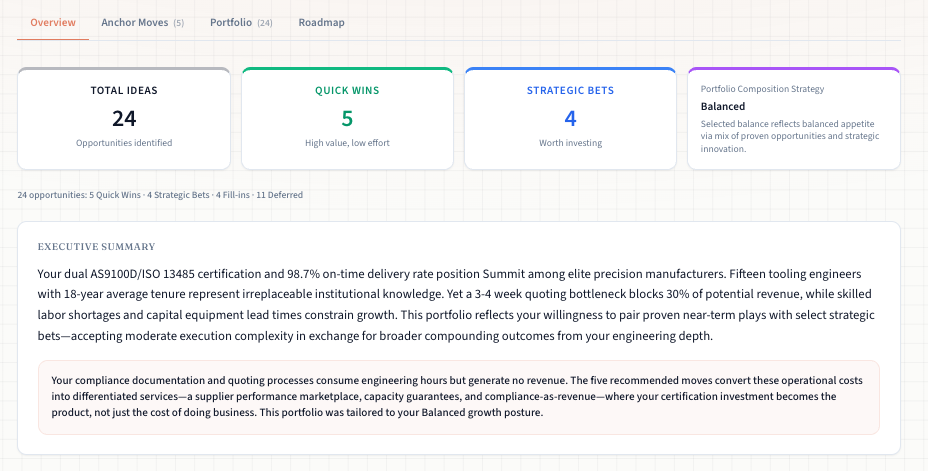
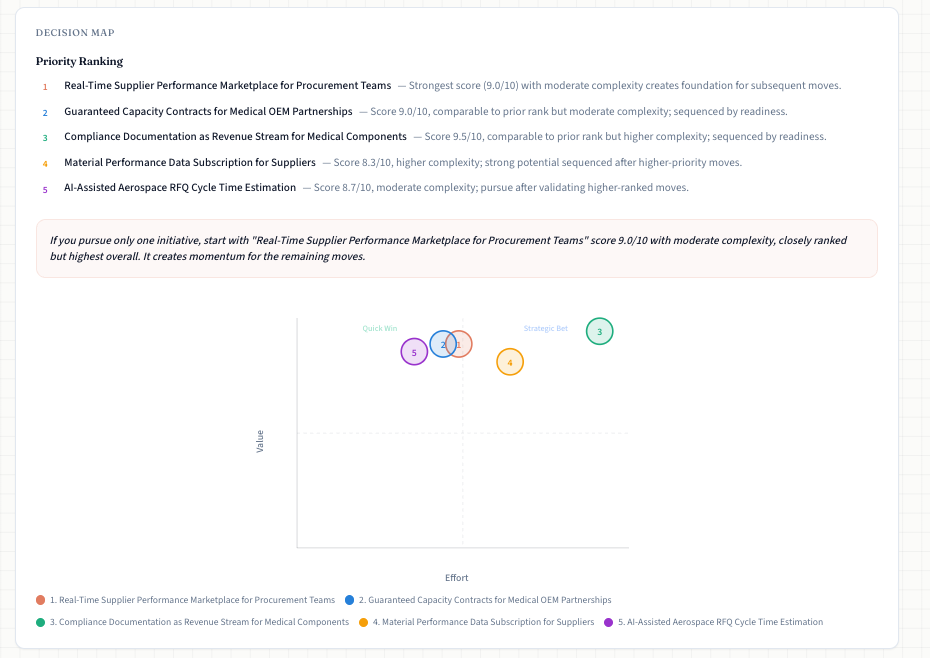
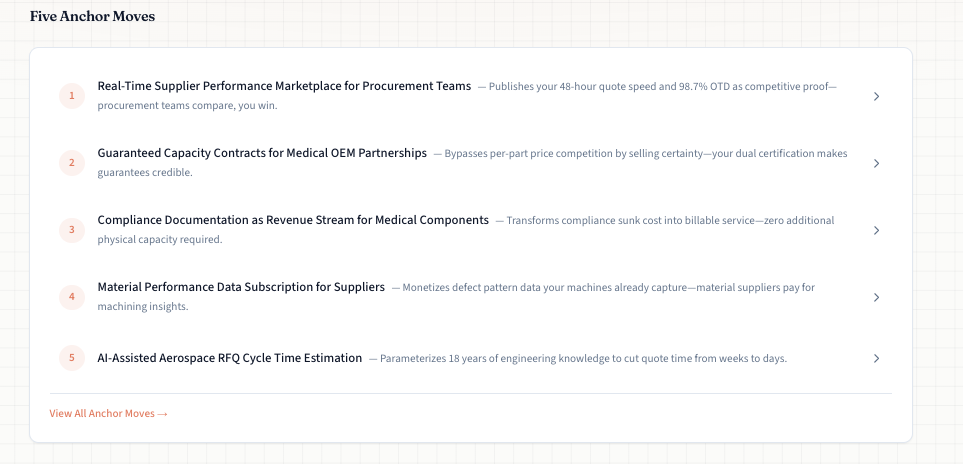
The outputs. Explore live, read deep.
You get an interactive dashboard to explore and stress-test the analysis, and a full PDF report with the thesis, the order and the reasoning for it, and the supporting evidence: the source material your team distills into the board summary.
Not screenshots. The actual outputs you’ll receive.
A category of its own:
innovation discovery, on demand.
Not gut feel. Not a multi-month consulting engagement.
A system built for the space between, where mid-market operators need evidence they can defend without waiting a quarter to get it.
Faster than meetings. Sharper than guessing. Not a retainer.
Not every company is a good fit, and the industries we cover are a short list. See who this is built for.
The parts people ask about.
Innovation discovery is the systematic analysis of what a company can actually do (its capabilities, constraints, and market position) to identify and rank the opportunities worth pursuing. It is Step 1, the front end of innovation: the work that generates and screens opportunities before the managed pipeline begins. The field has long numbered it zero and called it prework, which is a large part of why it gets the least attention of any phase.
The distinction matters because this is the weakest-run part of the process, not the missing one. The research has called the front end one of the weakest areas of the innovation process for more than twenty years. Most companies do produce a list — in a room, from what was already in the building — and then manage it downstream with far more rigor than went into making it.
Discovery. Innovation management software gives you a pipeline, a voting mechanism and a stage gate. All of that assumes the ideas going in are worth managing. Deciding which ideas belong there in the first place is a separate piece of work, and it is the one most mid-market companies do least well.
Running it thin is rational rather than lazy: doing it properly has meant either guessing in a room or paying a consultancy for eight weeks. Hephanos exists to make it a third option: one structured pass, answered the same day.
A chatbot answers from general knowledge in seconds. Hephanos works from your business in hours.
The difference is not that AI is involved. Everyone has AI now. It is that the work runs a structured path with scoring, traceability and validation logic, so the output can be inspected and challenged rather than taken on faith.
A chatbot can give you a clever answer. Clever is cheap. Wrong clever is expensive.
An interactive dashboard and a full PDF report. Inside: a broad set of opportunities evaluated and scored, your top five moves ranked by evidence and impact, the reasoning behind each, and the validation criteria that would tell you whether a move is working.
It is built to survive a leadership meeting, including the part where someone disagrees with it.
A short, focused intake. After that, Hephanos does the heavy lift and the report comes back the same day.
No standing meetings, no weekly calls, no parade of consultants discovering your org chart. You provide the context. We produce the analysis. You decide what deserves action.
We guarantee rigor, not agreement. Every analysis runs the same structured path, whether what comes out is flattering or not.
What we guarantee is delivery: if something we said would be in your report isn’t there, we re-run it, no charge and no argument. What we cannot guarantee is that you will agree. Useful strategy tends to land between “we knew that” and “that’s not us,” and the second one is often where the value is hiding.
Forge your next move.
Your next leadership meeting is coming either way. Walk in with five moves you can defend, scored and ranked with the evidence attached, or with the same list as last quarter. If the report doesn’t contain what we said it would, we re-run it free.
Early members get the largest founding-cohort discount.