What Is Innovation Discovery? A Definition That Fits an Operating Company
We use "innovation discovery" to mean a directed search: what you know about your business decides which research is worth doing, and the surviving candidates come back ranked.
September 2, 2026 · Updated September 26, 2026
You typed "innovation discovery" into a search bar and got back something about patent databases, trend monitoring, and competitive intelligence scanning.
If you run operations at a manufacturer, that answer probably felt off. Technology scouting is a real discipline, and practiced well, it is highly directed. The generic version, though, starts from a technology field rather than from the problem your company needs to solve.
You've probably heard the opposite too: your best opportunities are already inside your own operation, and the job is to surface what your team already knows. That practice is also real. For many companies it is the right first move. Your floor team can probably walk you to a constraint in fifteen minutes.
It does have a boundary. Not the one people assume. Done properly, with observation and operational data, an inward search does surface constraints nobody had put into words. It can't reach outside the organization: demand shifts, technologies, and cross-sector approaches your company has not encountered.
We use the term for the work that connects the two:
Innovation discovery is a directed search. What you know about your business decides which research is worth doing; the search runs outward; every candidate is assessed against your context; and what survives comes back as a scored, ranked set.
Other definitions are in circulation. This is the one we work to, and we state it plainly so you can tell which meaning is in play when you meet the phrase elsewhere.
What does it actually produce?
Three things, and they are worth separating:
- Opportunities you had not seen. The point of searching outward.
- Directions you had already suspected — now with evidence behind them and a place in the order.
- An assessment of every candidate, and a rank on the ones that survive it, so the order can be defended rather than argued.
The second one matters more than it sounds. Being told that the thing you have been circling for eight months holds up, and ranks third rather than first, is a decision you couldn't make before.
Why is a generic outward scan not enough?
None of it is aimed at you.
When competitors lean on the same benchmarks, trend services, and consulting decks, their priorities can converge. That is Roger Martin's argument in his 2023 essay "Benchmarking is for Losers," and our reading of it here: where the inputs are shared, the conclusions tend to be too. A scan that starts in a technology field rather than with your problem can return much the same material to anyone in your industry.
Why isn't searching only inward enough, either?
What to do next is not always in the building.
None of this knocks inward work. Your operation holds knowledge no outside source has: which constraint actually binds, what a workaround has quietly become standard, which customer request keeps arriving. Observation and operating data can draw out plenty that nobody has said aloud yet.
Inward work can't reach past the organization. Demand shifting in a segment you do not serve, a technology maturing in an industry you do not watch, an approach that is standard somewhere you have never looked: none of that is available to any amount of internal inquiry. That's what outward research is for.
Your own knowledge just changed jobs. It's the best steering information you have, and it still isn't the list of opportunities.
Side by side, the three approaches look like this:
| Outside-in scan | Inside-out review | Directed search | |
|---|---|---|---|
| Starts from | A technology field or trend | Your people, data and constraints | What you know about your business |
| Looks | Outward | Inward | Outward, aimed by your context |
| Good at | Seeing what the market is moving toward | Surfacing constraints nobody has put into words | Finding candidates you had not seen that fit you |
| Can't reach | Your problem, unless someone aims it | Anything your organization has not encountered | Whatever you leave out of the description |
| Hands back | Reports and signals | A list, often unranked | A scored, ranked set |
So how does the steering actually work?
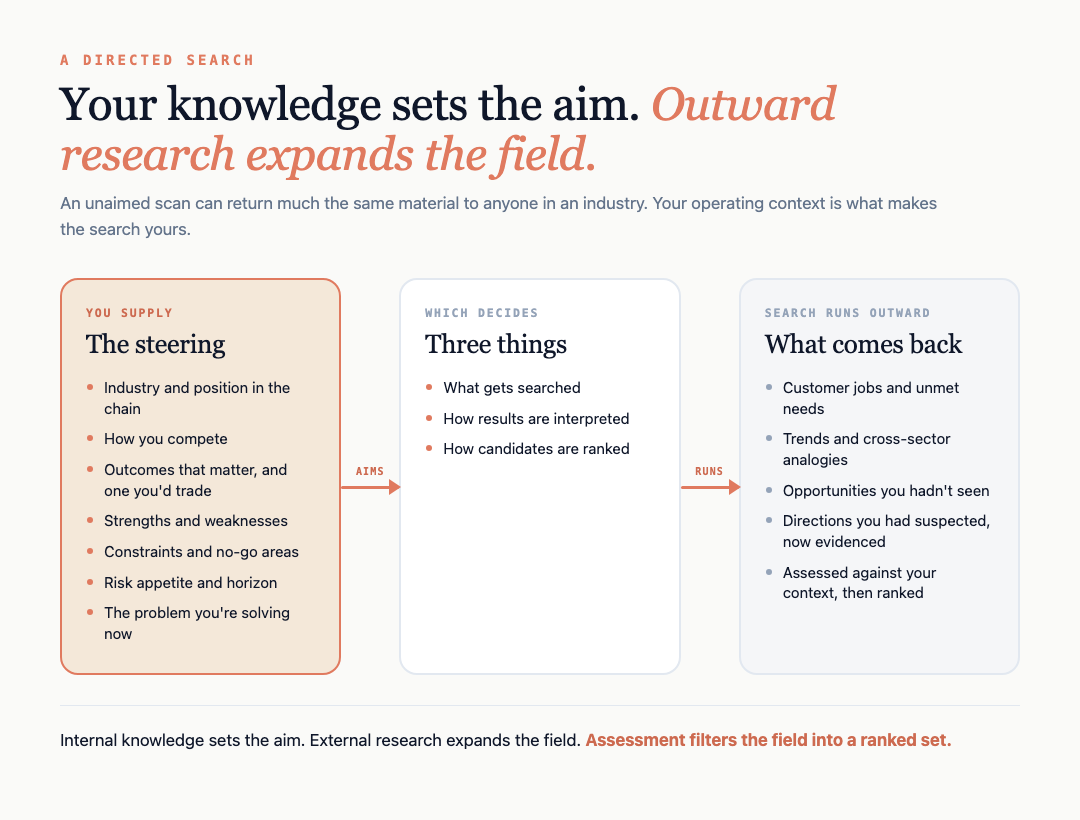
You describe the business, not the ideas.
Which industry and where you sit in the chain. How you compete. Which outcomes matter in the next two to three years, and which one you would trade away. What you are genuinely good at, and what you are not. What is off limits. Your appetite for risk and your time horizon. And the problem you are actually trying to solve right now.
Each of those changes one of three things: what gets searched, how the results are read, or how they are ranked. If you tell us you compete on responsiveness rather than cost, a different set of research is worth doing. Mark something as a hard non-negotiable, and candidates that violate it are excluded outright; flag a softer capability gap, and dependent candidates survive with a lower fit score and a lower rank.
That is the mechanism, and it describes how the system is built rather than what it has returned for any particular company.
So what does innovation discovery actually mean?
The underlying stage is well established, whatever you call it. Koen and colleagues define the fuzzy front end as "those activities that come before the formal and well-structured NPD process" (Koen et al., 2002, p. 30, n. 1). Their model breaks it into five elements: opportunity identification, opportunity analysis, idea generation and enrichment, idea selection, and concept definition.
They were also blunt about where the difficulty sits, in 2002, long before anyone could generate ideas on demand:
"In most instances, the problem is not coming up with new ideas… The problem for most businesses is in selecting which ideas to pursue in order to achieve the most business value." (Koen et al., 2002, p. 22)
The same group had already set out, a year earlier, to give that front end "a common language" (Koen et al., 2001). Cooper's Stage-Gate makes the order explicit: its overview places Discovery and Ideation upstream of Stage 1 (Cooper, n.d.). Dedicated methods are decades old; van Wulfen's FORTH method, published in 2011, exists to "unfuzzify" this exact point (van Wulfen, 2016).
Look at the dates. The selection bottleneck predates generative AI by two decades. AI changed the speed and the volume; choosing between the candidates is exactly as hard as it was in 2002. More supply just makes the pile bigger.
Where does discovery sit next to portfolio management?
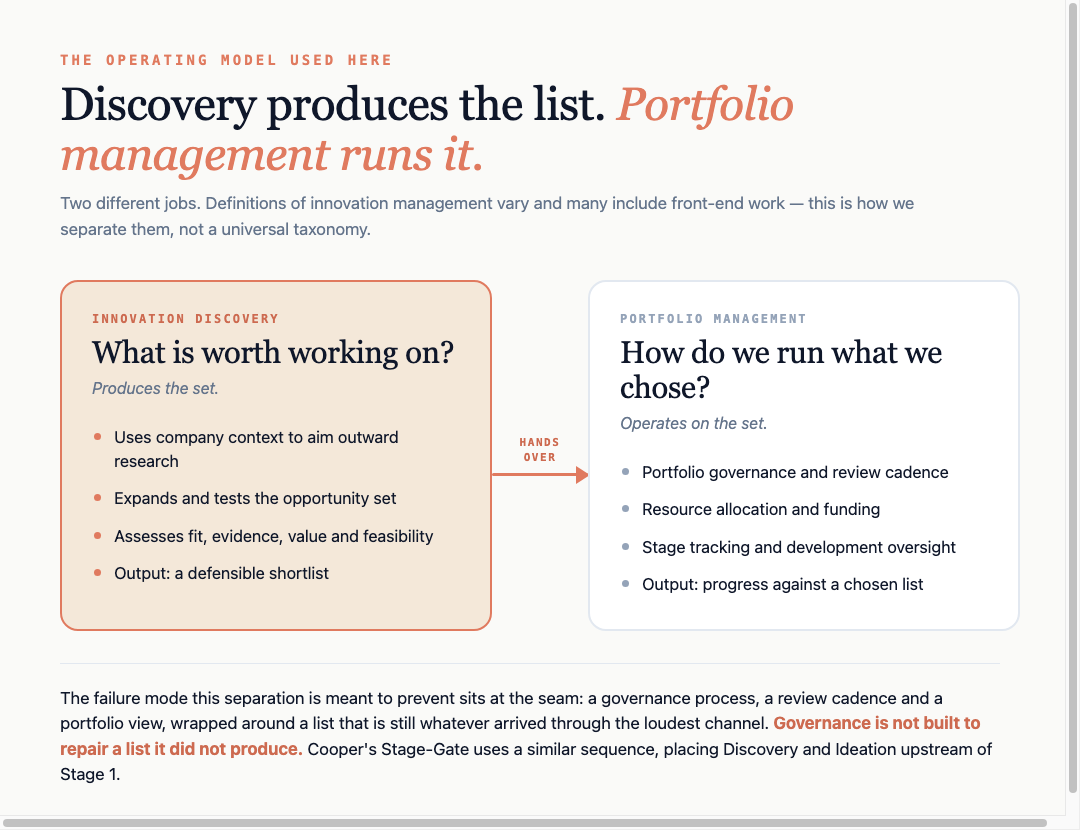
In the operating model we use, discovery produces the opportunity set, and portfolio management governs what is selected from it. Our view, stated plainly: discovery comes before innovation management. That is our position. It builds on the order Stage-Gate and the fuzzy-front-end research already describe; neither makes the claim for us. Definitions of innovation management vary, and many include front-end work, so this separation is ours, not a universal taxonomy.
We draw it to stop this: a governance process, a review cadence, and a portfolio view, wrapped around a list that still arrived through the loudest channel. Governance isn't built to repair a list it didn't produce.
What does a ranked output look like?
A discovery output is a scored set in which each item is tied to a named constraint or opportunity, and the order can be explained to a board with evidence. An unranked list can hold real thinking, but on its own it doesn't provide a repeatable basis for weighing one item against another, or an answer six weeks later when someone asks why an item is first.
Two illustrative candidates show the weighing. A secondary heat-treat capability: two inquiries this year, no committed volume, reusing an existing furnace line. Thin on demand, strong on feasibility. A changeover delay on the main cell: named by three people on the floor, visible in schedule attainment, never costed. Severity is high; fix cost is unknown.
The changeover delay advances to validation first, because the constraint is observed and sits on the critical path. The next step is to quantify the cost before the ranking is final. You can defend that. Discovery handles incomplete evidence instead of manufacturing certainty.
Three signs your process is missing a discovery step
These are our working diagnostics, not research findings. Treat them as hypotheses to test against your own process.
- You can't defend your current priority order to your executive team or your board on evidence rather than gut feel or meeting dynamics.
- Every option on your list came from inside the building. Nothing on it would have surprised anyone in the room.
- This year's list is last year's list with new labels. Persistent constraints are normal; the tell is that nothing in your process could have changed the order even if the right priorities had shifted.
None of these mean your organization has an innovation problem. They point at a missing stage. Knowledge and effort are rarely the shortage.
Discovery, Lean and Six Sigma answer different questions. Discovery compares opportunities across the business; Lean and Six Sigma improve processes already selected for attention. They can run alongside each other.
How do you check your own process?
Five questions about your own operation. Answer them for this year's list as it stands:
- Can you name your top five opportunities right now, in order, with evidence behind the order?
- Is that order written down, or does it live in the room?
- Could you show your CEO why the first item outranks the second?
- Did any option come from outside the building: a customer shift, a technology, a practice from another industry?
- When a supervisor spots a recurring constraint, does it have a way onto that list, and a way to be weighed against everything else on it?
A "no" on the first three means the ranking step is missing. A "no" on the fourth means you have a well-run inward process and no outward one. That's common. It's entirely fixable. It says nothing about how hard your team works.
For the mechanics of turning a scattered list into a scored shortlist, see how to build an innovation portfolio from scratch. To see how we run it, how Hephanos Innovation works.
Start with what you know. Then look further than it reaches.
Common questions
What is innovation discovery?
We use the term for a directed search: what a company knows about itself — its strategy, strengths, constraints, and the problem it is trying to solve — decides which research is worth doing; the search runs outward; each candidate is assessed against that context; and what survives comes back ranked. It is the stage that decides what enters a development or improvement pipeline. Online, the same phrase can also refer to technology scouting. Both usages circulate; this is ours.
Is this inside-out or outside-in innovation?
Both, in sequence. Inside-out work is a real practice and often the right place to start; with observation and operating data, it surfaces plenty that nobody had yet articulated. What it can't reach is outside the organization. Outward research reaches further, but if it's unaimed, it can return much the same material to anyone in the industry. The useful version uses the first to aim the second.
How does discovery relate to innovation management?
In the operating model we use, discovery produces the opportunity set, and portfolio management governs what is selected from it. Definitions of innovation management vary, and many include front-end work, so we draw this separation deliberately rather than as a universal taxonomy. Cooper's Stage-Gate uses a similar sequence, placing Discovery and Ideation upstream of Stage 1.
Is innovation discovery the same as continuous improvement?
No, but they don't compete. Lean and Six Sigma improve processes already selected for attention; discovery compares opportunities across the business to decide what deserves it. Both can run at once.
Has AI changed any of this?
It changed the supply. Producing plausible candidates is cheap now. Ranking became the scarce part, not the afterthought. In our system, a model applies a defined scoring rubric to the evidence gathered for each opportunity, and deterministic code then enforces operations such as sorting; the rubric and the evidence requirements make that judgment inspectable. The evidence behind the design is in can AI actually do innovation discovery?.
Sources
- Koen, P.A., et al. (2002). "Fuzzy Front End: Effective Methods, Tools, and Techniques." In The PDMA ToolBook for New Product Development, ch. 1, pp. 5–35. Wiley. Both quotations were checked word-for-word against the chapter text: the definition at p. 30 (endnote 1), the idea-selection passage at p. 22.
- Koen, P.A., et al. (2001). "Providing Clarity and a Common Language to the 'Fuzzy Front End.'" Research-Technology Management 44(2), 46–55. https://www.tandfonline.com/doi/abs/10.1080/08956308.2001.11671418
- Cooper, R.G. "The Stage-Gate® Idea-to-Launch System: an overview." Discovery and Ideation precede Stage 1. https://www.stage-gate.com/blog/the-stage-gate-model-an-overview/
- Wulfen, G. van. Creating Innovative Products and Services: The FORTH Innovation Method. Routledge (2016). https://doi.org/10.4324/9781315574615 (first published by Gower, 2011)
- Martin, R.L. (2023). "Benchmarking is for Losers." https://rogermartin.medium.com/benchmarking-is-for-losers-4e84a5387358
Our process is described here as architecture and positioning, not as outcome claims. Manufacturing examples are illustrative unless a source is named.*