How to Run a Strategic Discovery Process With a 3-Person Team
A structured four-phase process lets three people with defined roles turn scattered ideas into a scored, defensible opportunity shortlist in 4 to 6 weeks.
July 1, 2026
The Planning Offsite Problem
The whiteboard fills up in January. Sticky notes, arrows, bold circles around the biggest bets. By February, it is gone: photographed once, never referenced again. When leadership asks about next year's growth path, you recycle the same three items from last year, slightly reworded, because there is no process to generate new ones. You answer based on what you already know.
This is not an execution problem or a culture problem. Among small and mid-market manufacturers, formal documented strategy is more often the exception than the norm. Research on manufacturing SMEs treats the presence of a written strategic plan as the marker of planning formality and finds that formality rises with firm size, which leaves the smaller end of the market planning informally [Ghobadian, O'Regan, Thomas & Liu, 2008]. Without a repeatable process, every annual cycle defaults to the same inputs and the same whiteboard.
Headcount and budget are real constraints. They are not the primary barrier. The barrier is the absence of a repeatable process, one that, as industry observers note, consulting firms have packaged behind six-figure engagements and enterprise teams have buried inside 10-person strategy departments. Three people with defined roles and a structured four-phase process can produce a scored, defensible shortlist of opportunities in four to six weeks.
Before going further: this process requires three people who can each commit four to six hours per week, and a Decision Maker with authority to act on the output. If those conditions are not in place, the process will stall mid-phase.
That starts with filling three specific roles before Phase 1 begins.
The Three Roles You Need Before You Start
Before Phase 1 begins, three functional roles must be filled: not job titles, but data access and authority assignments that map to real people on your team.
The three-role configuration is the unit of analysis: a two-role attempt breaks at specific phases.
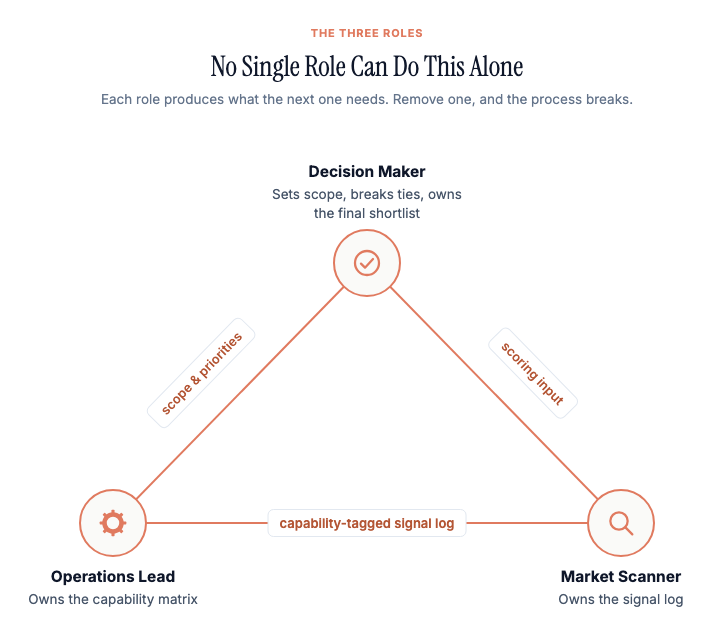
Roles by Phase
| Phase | Operations Lead | Market Scanner | Decision Maker |
|---|---|---|---|
| 1 | Pulls ERP records, capacity utilization, tooling inventories, margin data. Produces capability matrix. | Reviews matrix; sets Phase 2 signal priorities. | Sets strategic scope for capability types. |
| 2 | Validates signals have operational grounding. | Pulls OEM spec changes, lost-bid records, customer conversations. Produces signal log. | Reviews signal log against strategic priorities. |
| 3 | Scores capability reuse and validation cost. | Scores market timing; surfaces counter-evidence. | Scores strategic fit; resolves score disputes. |
| 4 | Designs capacity and feasibility tests per Anchor Move. | Owns customer and competitive validation. | Approves validation plan; presents shortlist to leadership. |
Role Clarity Check
Before assigning each person, confirm:
- Operations Lead: Direct access to ERP records, capacity data, and product-line margin data, plus relationships to get honest production numbers without a middleman.
- Market Scanner: Existing customer, distributor, or OEM contacts reachable without a formal sales process; direct access to lost-bid records.
- Decision Maker: Clear, unquestioned authority to commit resources to a new direction. "Subject to board approval" is conditional, not authority. If someone outside this process must approve the output, that person is the Decision Maker.
Prerequisite Inputs
Phase 1 requires, at minimum:
- ERP records
- Product-line margin data at SKU or line level
- 12 months of capacity utilization records
- Supplier or tooling inventories in documented form
Without these, capability mapping produces guesses.
What Partial Commitment Breaks
A Market Scanner managing two concurrent initiatives and contributing sporadically breaks Phase 2. Signal gathering requires sustained attention: OEM spec windows close, customer conversations require scheduling. Phase 3 needs a complete signal log. A partial one stalls the process.
When all three roles are filled and the needed data exists, Phase 1 can begin. The Operations Lead owns it.
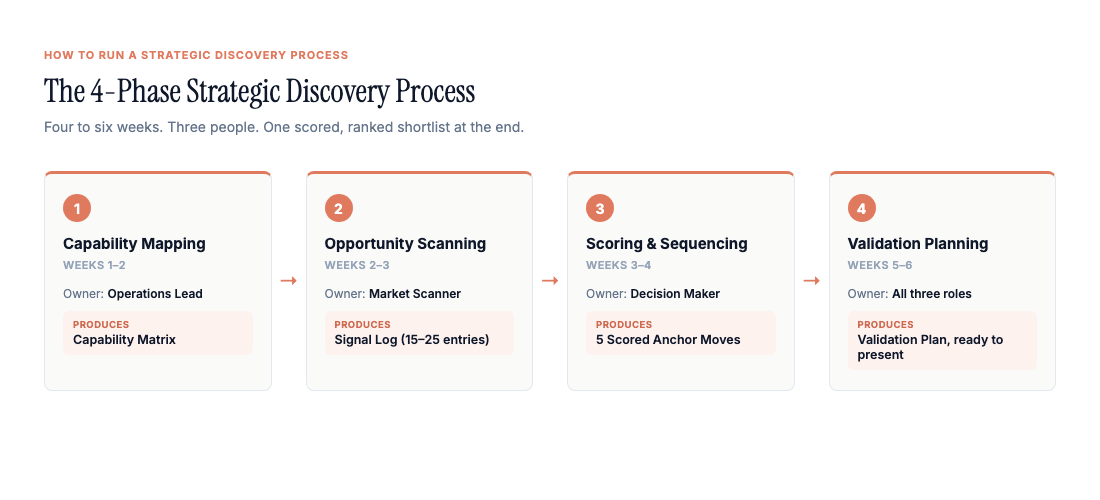
Phase 1: Capability Mapping (Weeks 1–2)
The Operations Lead's mandate in Phase 1 is specific: produce a documented inventory of what the plant can actually do: not what leadership believes it can do, not what the sales team promises customers. Capability mapping starts with structured questions, not ERP exports.
Questions That Surface Real Capability
Ask these across every production line and process area:
- What is our current capacity utilization by line, and what is the realistic upside without capital investment?
- Which tooling do we own that runs below 50% utilization in a typical month?
- Which product lines carry the highest margin, and what process expertise makes that margin possible?
- Where have we won contracts in the last two years that surprised us, and what did we actually do that the customer could not source elsewhere?
- Which workforce skills exist in the plant that do not appear in any current product line?
A two-hour session working through these five questions produces more decision-relevant data than the last planning offsite, because it documents demonstrated output, not ambition.
Data Sources
Pull from:
- ERP records (production volume, run rates)
- 12-month capacity utilization reports
- Tooling inventories
- Product-line margin data at the SKU or line level
- Workforce skill records
ERP data is a starting point: the Operations Lead must validate it against plant-floor reality because system records frequently lag actual capability or reflect an earlier product mix.
The Capability Matrix
The output is a one-page matrix. Each row is a distinct capability: not a department, not a product, but a specific thing the plant can actually demonstrate it can do. Columns:
- Capability name
- Current utilization level
- Tooling required
- Relevant product lines
- Margin tier (high / medium / low)
- Notes field for constraints
Sufficient coverage means every major production area is represented. The test: could an outside operations director read this matrix and know what the plant can actually bid?
What Is Genuinely Hard
Two things break Phase 1:
- Plant floor managers are protective of their capacity numbers. They own the miss if they commit a number and fall short. Frame Phase 1 as inventory, not commitment. "What do you typically run in a normal week?" produces a number; "What can you run?" creates defensiveness.
- Knowing when the matrix is complete enough to move on. The threshold is functional, not perfect: at least one documented capability per major production area, each validated against a real data source rather than stated from memory.
That validated capability matrix is what the Market Scanner needs to filter the signal log. Phase 2 is next.
Phase 2: Opportunity Scanning (Weeks 2–3)
With the capability matrix validated, the Market Scanner takes over: aim to find 15 to 25 external market signals that connect to at least one documented capability from Phase 1. That range is a practical guideline: fewer than 15 usually means the scan missed categories; more than 25 makes Phase 3 scoring unworkable.
What the Market Scanner Reads
Five source types commonly used in discrete manufacturing:
- IndustryWeek and Manufacturing Dive for new-product coverage and sector trend reporting
- OEM specification change notices on supplier portals when component requirements or source approvals shift
- IMTS session agendas and exhibitor listings, which surface competitive launches before they reach the trade press
- Structured customer conversations asking which problems they solved in the past 12 months and what they could not source elsewhere
- Lost-bid debriefs: structured debriefs produce high-signal data when a competitor won business the team pursued; unstructured ones focused on price produce noise
The Signal That Makes Phase 2 Urgent
The Market Scanner opens a trade publication and finds a competitor's product announcement. The product line the team had been evaluating internally for two years launched six months ago. The competitor has won three accounts. The Market Scanner cross-references the announcement against the capability matrix, finds a match in two documented capabilities, and logs it as confirmed external market evidence rather than validation of an internal hunch.
The Confirmation Bias Rule
A signal must be traceable to an external source before it enters the log: a named publication, customer conversation, competitor announcement, OEM notice, or lost-bid record. Internal conviction does not qualify. If the only evidence is that the team believes an opportunity exists, that is a preference, not a signal.
The Signal Log
Each row represents one market signal. Columns:
- Signal description
- Source
- Date
- Capability tag from the Phase 1 matrix
- Keep/cut decision
Both conditions are required: the signal connects to at least one documented capability and traces to an external source. A signal that matches a capability but originates from an internal discussion is cut.
A practical threshold for moving to Phase 3 is 15 to 25 entries, each tagged to at least one Phase 1 capability. At that threshold, the Decision Maker logs it for scoring.
Phase 3: Scoring and Sequencing (Weeks 3–4)
The Decision Maker takes the signal log from Phase 2 and owns Phase 3: score every entry across four dimensions, identify the Anchor Moves (the top five scored opportunities), and produce the prioritized shortlist for leadership.
Four Dimensions
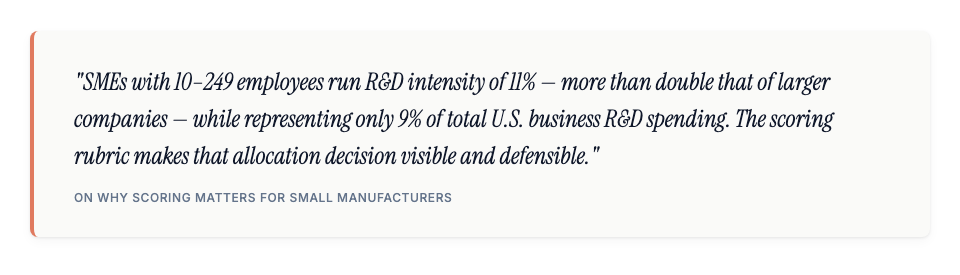
These four dimensions are not derived from academic research, and that is appropriate, because this process does not live in research papers. It lives in RFQ debrief rooms, plant-floor conversations, and lost-bid calls, where a manufacturer learns what a competitor built while they were still planning. The rationale for each dimension:
- Strategic fit comes first because it determines whether the move belongs in this business at all. An opportunity that does not advance the manufacturer's stated direction should not reach the shortlist, regardless of how easy it is to capture.
- Capability reuse is the execution multiplier. An opportunity the plant can pursue with existing tooling and process knowledge moves faster, costs less, and carries lower technical risk than one requiring all-new development.
- Market timing is the most volatile dimension and the most gameable. External demand evidence (an OEM notice, a competitor announcement, a confirmed customer request) is verifiable. Internal conviction that demand is coming is not. Score market timing on evidence, not optimism.
- Validation cost is a feasibility gate, scored inversely. High validation costs do not make an opportunity less valuable; they make execution slower and more resource-intensive. Score it to surface sequencing constraints, not to disqualify.
Tag the bet type before scoring. Not every signal in the log is the same kind of bet. A signal that extends a capability already in the Phase 1 matrix is a different animal from one that would require the plant to do something it has never done. Before scoring, the Operations Lead tags each signal proven-adjacent (matches an existing capability directly) or genuine-unknown (no direct match; would require new capability development). The four dimensions still apply to both, but a genuine-unknown signal that scores well on Strategic Fit and Market Timing needs a cheaper, faster Phase 4 validation step than a proven-adjacent signal with the same total; it carries more assumption risk per point of Capability Reuse.
Scoring Rubric
| Dimension | Score 1 | Score 3 | Score 5 |
|---|---|---|---|
| Strategic Fit | Adjacent to current lines; no overlap with stated strategy | Supports a stated strategic direction but not a current priority | Directly advances the manufacturer's primary growth strategy and named customer segments |
| Capability Reuse | Requires all-new tooling, process development, and materials sourcing | Reuses some tooling; requires modest process adaptation | Uses existing tooling, materials, and process expertise with minor adaptation |
| Market Timing | Speculative window; no external demand evidence | Demand signals present; competitive window crowded | Active demand confirmed (OEM notice, lost-bid, competitor launch) alongside strong strategic fit |
| Validation Cost | Requires pilot tooling, materials qualification, or dedicated engineering allocation | Internal testing and 1–2 customer conversations; modest resource draw | Customer conversation and capacity check using existing equipment |
Worked Example
A plant with precision CNC capability receives an OEM spec change notice requiring tighter tolerances on medical device housings. The Operations Lead confirms the capability is in the matrix at 60% utilization with existing tooling.
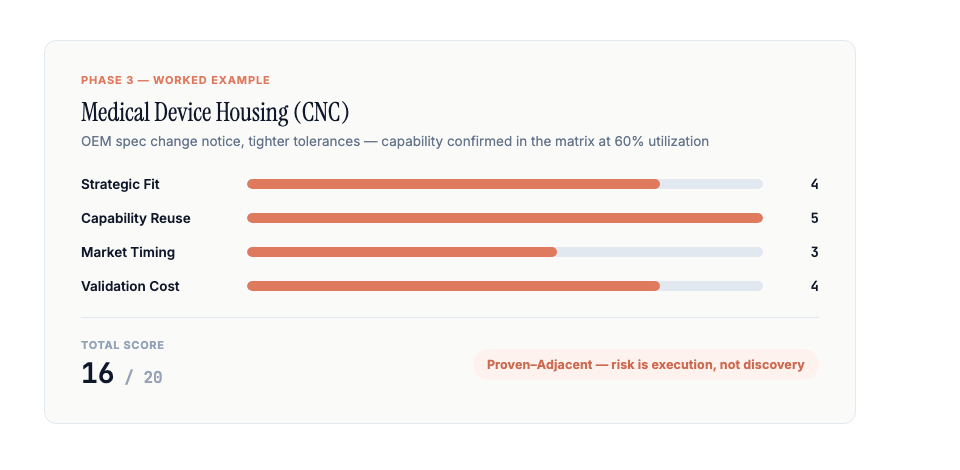
- Strategic Fit: 4. The plant has named medical components as an adjacency, but it is not the primary growth priority.
- Capability Reuse: 5. Existing CNC tooling with minor fixture adaptation.
- Market Timing: 3. The OEM notice confirms demand, but two known competitors have already responded.
- Validation Cost: 4. One customer conversation and a capacity test on existing equipment.
Total: 16. Bet type: proven-adjacent. Existing CNC tooling with minor fixture adaptation; the primary risk is execution, not discovery. In a 20-entry table, that places third, ahead of speculative opportunities with no external demand evidence, behind a confirmed OEM signal with stronger strategic fit.
The Scoring Table
The scoring table has seven columns:
- Opportunity Name
- Strategic Fit (1–5)
- Capability Reuse (1–5)
- Market Timing (1–5)
- Validation Cost (1–5, inverted)
- Total Score
- Rank
Each of the 15–25 signals from the Phase 2 log becomes a row. The Decision Maker sums each row and ranks.
When the Rubric Resolves a Judgment Call
The moment the rubric earns its place: two opportunities score identically on Strategic Fit and Capability Reuse.
- Opportunity A: confirmed OEM demand notice. Market Timing: 5.
- Opportunity B: speculative, no external evidence. Market Timing: 1.
The rubric surfaces an 8-point gap that gut feel would have treated as a coin flip. The Decision Maker does not need to arbitrate between advocates; the evidence basis does it.
Anchor Moves
The top five rows by total score are the Anchor Moves: the shortlist the Decision Maker brings to leadership.
- It's a ranked position, not a score threshold. The sixth opportunity remains on the backlog regardless of its absolute total.
- The Decision Maker can reorder within a tight score band when one opportunity unlocks another.
- The total score guides sequencing; it does not replace judgment.
Disagreement Resolution
When scores diverge (the Operations Lead rates capability reuse a 4; the Market Scanner rates market timing a 2), the Decision Maker holds the final number. The Decision Maker is responsible for defending the scored table to leadership, which makes the score solid rather than just written down.
Phase 3 is complete when the scoring table exists, the top five Anchor Moves are named, and the Decision Maker can explain the reason behind each score. Before taking the shortlist to leadership, each Anchor Move needs one validation next step: that is, Phase 4.
Phase 4: Validation Planning (Weeks 5–6)
The scored Anchor Moves table names what to pursue. Phase 4 determines what to check first. Each Anchor Move gets one validation step, answering its single highest-risk question before engineering time or capital moves.
Validation planning is not market research. Each Anchor Move gets one question: the question whose unfavorable answer would remove it from consideration. Each move carries a different primary risk: demand, feasibility, or competitive timing. The Decision Maker names it; the team does not reach consensus on it.
Four Validation Methods Without a Research Budget
- Structured customer conversation (30-minute call asking about unmet needs in the candidate area): answers whether external demand exists
- Capacity test (one-day modified production run): answers whether the plant can execute at required yield and cycle time
- Lost-bid debrief (structured call with a customer who chose a competitor): answers whether the capability gap is closable or structural
- Trade publication scan for competitor announcements in the area: answers whether the window is opening or already populated
What a Validation Conversation Reveals
The Market Scanner calls a customer about the top-ranked Anchor Move, a candidate for precision components in a new product family. The customer says the problem is already solved: a competitor delivered a qualified part six months ago, and re-sourcing is off the table. This is not a process gap with an assignable next step. It is a discovery gap: the validation revealed a constraint that rules the move out, and it returns to the backlog. "We have not validated this yet" has a next step, and the move stays on the shortlist. "This opportunity is not real" does not. The Decision Maker makes this call.
The Validation Plan
| Anchor Move | Highest-Risk Question | Validation Method | Owner | Deadline |
|---|---|---|---|---|
| Medical device housing (CNC) | Will the customer commit to a qualification order once tolerances are met? | Structured customer conversation | Market Scanner | Day 12 |
| (illustrative: one row per Anchor Move, five rows total) |
- The Operations Lead owns capacity tests.
- The Market Scanner owns customer conversations, debriefs, and publication scans.
- The Decision Maker owns validations requiring a customer relationship.
The Go/No-Go Check
Before scheduling the leadership presentation: every Anchor Move needs a named method, a named owner, a deadline within 30 days, and one more test: would this Anchor Move survive its named owner stepping away for two weeks? If execution depends on that person's direct, hands-on involvement rather than a role that could be reassigned, name it in the validation plan. A shortlist that only works if one specific person stays available all quarter is funding a person, not a plan. Any row missing any of these four checks: the shortlist is not ready to present.
At the end of Phase 4, the team holds five Anchor Moves, each with a validation plan, an owner, and a 30-day deadline. That is what the Decision Maker presents to leadership.
What This Process Can and Cannot Do
You now hold five scored Anchor Moves with validation plans. Here is what that output is not.
What this process cannot replace
- Full market research: structured analysis of segments, willingness to pay, and competitive dynamics. Need it: hire a research firm.
- A multi-year strategic plan: the output is a shortlist, not a roadmap. Need one: engage a strategy consultant.
- Leadership judgment: the Decision Maker decides which Anchor Move to fund and when. No rubric replaces that call.
Two conditions that break the process
Partial commitment to any required element does not slow the process; it breaks it.
| Failure Mode | Check Before Starting |
|---|---|
| Decision Maker cannot commit to phase reviews | Can the DM block two hours per week for 4–6 weeks and own each scoring session? If not, Phase 3 stalls. |
| No existing operational data | Does the plant have ERP records, capacity utilization data, and one product-line margin analysis? If not, Phase 1 cannot produce a capability matrix. |
What separates this from the annual offsite, structurally
The offsite produces a brainstormed list with no scoring criteria and no role-assigned follow-through. This process produces a scored, sequenced shortlist with a scoring rubric, role-assigned validation steps, and a named decision owner. The difference is not discipline. It is the scoring rubric and defined roles.
For most mid-market manufacturers, formal strategic planning at the enterprise level is not in place. This process is not a substitute for that; it is a structured entry point where one did not exist.
If both preconditions are met, the process works.
What a Finished Discovery Looks Like (and One Faster Path)
Here is what the output looks like when the Decision Maker walks it into a leadership meeting.
The Anchor Moves Shortlist
Five entries. Each contains:
- Opportunity Name
- Scores across four dimensions (Strategic Fit, Capability Reuse, Market Timing, Validation Cost) on a 1–5 scale
- Total Score (maximum 20)
- Rank (1–5)
- Validation Next Step with method, owner, and 30-day deadline
- One sentence stating why this opportunity made the shortlist
One page or five slides.
Presenting It So Leadership Takes It Seriously
Three elements make the shortlist defensible rather than just documented:
- Every score is traceable to a specific data source, a capability matrix line item or a signal log entry. Not an assertion.
- Every Anchor Move has a named next step with an owner and a 30-day deadline, signaling the team has already thought past the idea.
- The Decision Maker presents the process before the scores (the four phases, the data gathered, the roles) so the output is received as a conclusion, not a recommendation.
Start Here
Assign three people to the named roles. Block six weeks on the calendar. Start with a two-hour capability inventory session using the five Phase 1 questions. The output of that single session (a documented map of what the plant can actually do) will produce more decision-relevant data than the last planning offsite.
"A scored, ranked shortlist of five Anchor Moves is the output. A whiteboard is not."
Key Takeaways
- Three defined roles (Operations Lead, Market Scanner, Decision Maker) are the prerequisite, not a nice-to-have.
- The four-phase process produces a scored, ranked shortlist in 4–6 weeks, not a whiteboard.
- The scoring rubric (strategic fit, capability reuse, market timing, validation cost) turns opinion into a defensible, scored table.
- Validation planning assigns one next step per Anchor Move before resources move.
One Faster Path
The manual process takes 4–6 weeks, and most of that time buys something Hephanos cannot replicate: three people who know the plant, drawing on real production history, customer relationships, and floor-level judgment the whole way through. What Hephanos adds is breadth of search, not a replacement for that judgment. From a short intake, it runs multiple AI agents through a structured market and competitive research process, scored against your stated competitive strategy, and returns a ranked set of candidate Anchor Moves within hours. That is closer to compressing the Phase 2 opportunity scan than replacing the whole process, at a fraction of the cost. The three roles still validate the signals, apply their judgment, and defend the shortlist to leadership.
Sources
- Ghobadian, A., O'Regan, N., Thomas, H., & Liu, J. (2008). "Formal Strategic Planning, Operating Environment, Size, Sector and Performance: Evidence from the UK's Manufacturing SMEs." Journal of General Management, 34(2). https://doi.org/10.1177/030630700803400201