Why Most Manufacturers Innovate by Accident (And How to Stop)
Most mid-market manufacturers produce innovation outputs the same way: by accident. A customer pushes back and a capability surfaces. A competitor wins a contract and a gap becomes visible. Understanding this pattern is the first step toward building something better.
May 6, 2026 · Updated September 2, 2026
The Competitor You Didn't See Coming
The email arrived on a Tuesday morning. A contract your plant had held for eleven years (precision components for a regional OEM) was moving to a competitor. The customer's note was brief: the new supplier had offered a capability you didn't know you were being evaluated on. Tighter tolerances on a specific alloy profile. Something your engineering team had been running in prototype for two years.
You pulled the team together. Someone pulled up the spec sheet. Within twenty minutes, the room arrived at a conclusion no one wanted to say out loud: you could have built that. The tooling was already qualified. The process knowledge was sitting in an engineer's notebook. You weren't beaten by a better manufacturer. You were beaten by one who happened to surface the right capability at the right moment.
That distinction matters, because the instinct after a loss like this is to look for the failure. The salesperson who didn't stay close enough, the VP who missed a signal, the quarterly review where someone should have raised it. None of those explanations are wrong, exactly. But they're not the cause.
What actually happened is structural. Your plant produces innovation outputs (new capabilities, new offers, new market moves) the same way most manufacturers do: by accident. A customer pushes back and a capability surfaces. A competitor wins a contract and a gap becomes visible. An engineer solves a problem no one knew they were solving. The outputs are real, but the process that generates them is invisible, undirected, and entirely dependent on luck.
This pattern has a name. Researchers call it accidental innovation. Understanding it is the first step toward building something better.
Accidental Innovation Is a Systems Problem, Not a Culture Problem
The term comes from academic research, not manufacturing practice. Austin, Devin, and Sullivan studied accidental innovation [Austin, Devin & Sullivan, 2012] in design and the arts, and what they found there was deliberate: the makers they observed did not merely stay open to accident but "intentionally design their processes and surroundings to invite and exploit valuable accidents." That is the directed version of the pattern. What runs in most plants is the undirected one — the same accidents, without the mechanism that would surface and exploit them. We have not identified academic work applying either version to manufacturing, which is part of why the pattern persists unnamed in plants like yours.
Why do competent manufacturers end up here? Not because of weak leadership or a culture that resists change. The structure guarantees it. When no formal mechanism surfaces capabilities, opportunities emerge by accident. When no scoring system evaluates them, resources follow the loudest voice. The system produces this outcome predictably, regardless of who is in the room.
This difference drives everything that follows: having an innovation culture is not the same as having an innovation process. A culture initiative runs an offsite, surveys the team on psychological safety, and posts values on the wall. A process scores opportunities against evidence, assigns owners, and produces decisions. One addresses motivation. The other creates mechanism. The failure modes that guarantee accidental innovation are structural and specific.
Two Failure Modes. Both Structural. Both Predictable.
The two failure modes operate simultaneously. Neither requires bad intent.
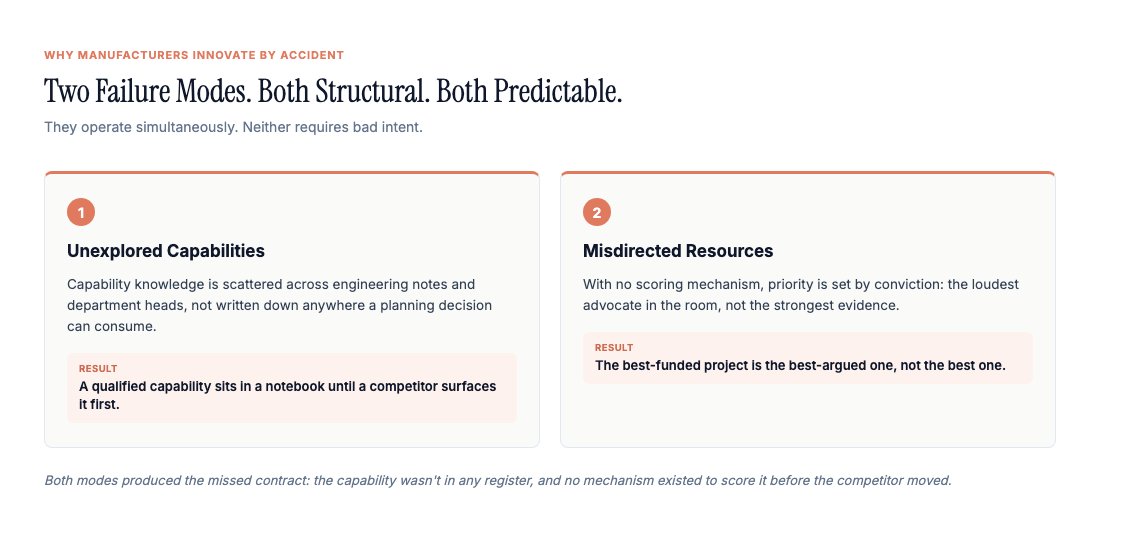
Failure Mode 1: Unexplored capabilities. Capability knowledge is scattered across engineering notes and department heads. No prioritized list feeds into a planning decision. In the competitor scenario, your engineering team had been running a qualified process on that alloy profile for two years. The knowledge existed: in a notebook, possibly in a 2019 CAD file that nobody cross-referenced against the customer's RFP. The evaluation criteria changed. The capability didn't surface. The contract moved. Not a communication failure. An architecture failure.
Failure Mode 2: Misdirected resources. When no scoring mechanism exists, priority is set by conviction. The project that gets funded is the one with the most senior advocate in the room at quarterly planning. This is not politics; it is the only available method of selection when evidence is absent. The loudest argument wins by default, not by design.
Which failure mode produced the missed contract? Both. The capability wasn't in any register (Failure Mode 1). And even if it had been, no mechanism existed to score it against an active customer requirement before the competitor moved (Failure Mode 2).
The workshop that went nowhere. You have probably run an innovation initiative. Kickoff session, cross-functional team, a deck with twelve identified opportunities. Six months later, nothing shipped. The common explanation is cultural: the team lost interest. The structural explanation is different: the deck identified opportunities but created no mechanism for scoring, sequencing, or allocating resources. Motivation was addressed. Mechanism was not.
This pattern is not rare. Only 5% of senior executives say they have reached the implementation stage of their Industry 4.0 journeys, while 54% have developed — or are still in the process of developing — a 4.0 strategy [BDO Industry 4.0 Middle Market Benchmarking Survey, reported by the Manufacturing Leadership Council]. The domain is digital transformation, not the innovation process specifically. But the structural dynamic is identical: a plan without a mechanism to execute it produces the same result every time.
Why ERP, CAD, and PLM Don't Close This Gap
These failure modes don't live in ERP. They don't live in CAD or PLM either. The investment in those systems was right; this is not an argument to replace them.
ERP tracks what your plant builds, schedules, and ships. CAD encodes what your engineers can design. PLM manages the flow of products from concept to release. These systems are purpose-built for operational execution, and they work. The problem is not that the infrastructure is wrong. The problem is that none of these systems was designed to answer a different question: what should we build next, and on what basis?
That question lives in a spreadsheet. For most mid-market discrete manufacturers, it is 50 tabs assembled before Q1 planning, last opened in March. It has no scoring column and no connection to the capability data already sitting structured in the systems alongside it. The spreadsheet is not a failure of effort. It is the best available tool for a job that no other system in the plant was designed to do.
A recognized structural challenge for discrete manufacturers is the gap between digital infrastructure investment and the ability to execute on it [EY-Parthenon, 2024]. It is not an outlier condition. The same dynamic holds for the innovation process: owning the tools does not mean having a process to direct them. Upgrading what already works does not close this distance.
The diagnosis is complete. The failure modes are structural. The gap above the infrastructure is real and recognized. A process layer to close it exists, and it is achievable at this size.
Systematic Discovery: What It Means, What It Isn't
Systematic innovation discovery is not a workshop format or a consulting process. It is a process layer defined by three structural properties. What follows is the author's synthesis drawn from the failure modes above (not an established academic or industry standard). It names what is absent when the accidental pattern persists.
Capability-first. It starts from what your plant can already build (materials, processes, tolerances, certifications). That is the aim, not the whole search: the same context then directs an outward look at customer needs, trends and approaches working in adjacent sectors. Starting from a trend report alone gives you what it would give anyone in your industry.
Scored. Every opportunity enters a mechanism that produces a decision, not just a list. The mechanism evaluates capability fit, customer alignment, and resource feasibility, then produces a rank. Conviction still matters; it cannot be the only input.
Repeatable. The process runs without anyone holding it together. If the prioritization changes when you step out, you have a person, not a process.
This is the mechanism difference from what you have already tried. A kickoff workshop produces inputs. Systematic discovery requires a layer that converts inputs into decisions, and runs again next quarter without a reset.
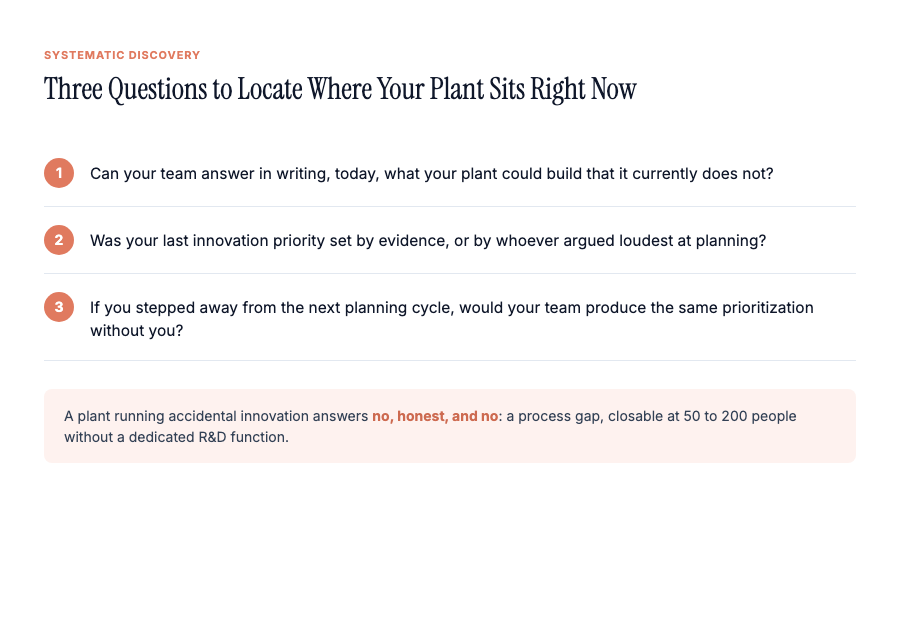
Three questions to locate where your plant sits right now:
- Can your team answer in writing, today, what your plant could build that it currently does not?
- Was your last innovation priority set by evidence or by whoever argued loudest at planning?
- If you stepped away from the next planning cycle, would your team produce the same prioritization without you?
A plant running accidental innovation answers no, honest, and no: a process gap, closable at 50 to 200 people without a dedicated R&D function.
Sources
- Austin, R., Devin, L., & Sullivan, E. (2012). "Accidental Innovation: Supporting Valuable Unpredictability in the Creative Process." Organization Science, 23(5). https://pubsonline.informs.org/doi/10.1287/orsc.1110.0681
- Manufacturing Leadership Council. "Kick-Starting Industry 4.0 for Mid-Market Manufacturers." Reporting figures from BDO's Industry 4.0 Middle Market Benchmarking Survey. Original URL no longer resolves; cited from the Internet Archive capture of 2021-10-16. https://web.archive.org/web/20211016091742/https://www.manufacturingleadershipcouncil.com/kick-starting-industry-4-0-for-mid-market-manufacturers-10430/
- EY-Parthenon (2024). "Is your digital strategy fit for the manufacturing future?" https://www.ey.com/en_us/insights/advanced-manufacturing/is-your-digital-strategy-fit-for-the-manufacturing-future
Corrections
2026-08-15. Corrected how this article represented its source for the term "accidental innovation," and softened an unverified claim in the same paragraph.
The article said Austin, Devin, and Sullivan defined accidental innovation as failing to design processes that "invite and exploit valuable accidents." Their paper says close to the opposite: the makers they studied "not only remain open to accident but also intentionally design their processes and surroundings to invite and exploit valuable accidents." We had inverted the source's meaning while quoting it accurately. The paragraph now reports what the paper found — the deliberate version — and presents the undirected version as our own contrast rather than theirs.
The same paragraph asserted that no subsequent academic work has applied this frame to manufacturing. We had not established that, and it is not the kind of claim a literature search can settle. It now says only that we have not identified such work.
2026-08-13. Two fixes to the Industry 4.0 statistic and its source.
The article said 54% of executives "already" had "a formal strategy in place." The survey says 54% "have already developed, or are in the process of developing" a 4.0 strategy — a weaker claim than we published. The sentence now matches the source.
The figures originate in BDO's Industry 4.0 Middle Market Benchmarking Survey, which the Manufacturing Leadership Council was reporting; the article credited only the Council. Attribution now names both. The Council's URL has since gone dead (404), so the reference points to the Internet Archive capture of 2021-10-16, where both figures remain verifiable.